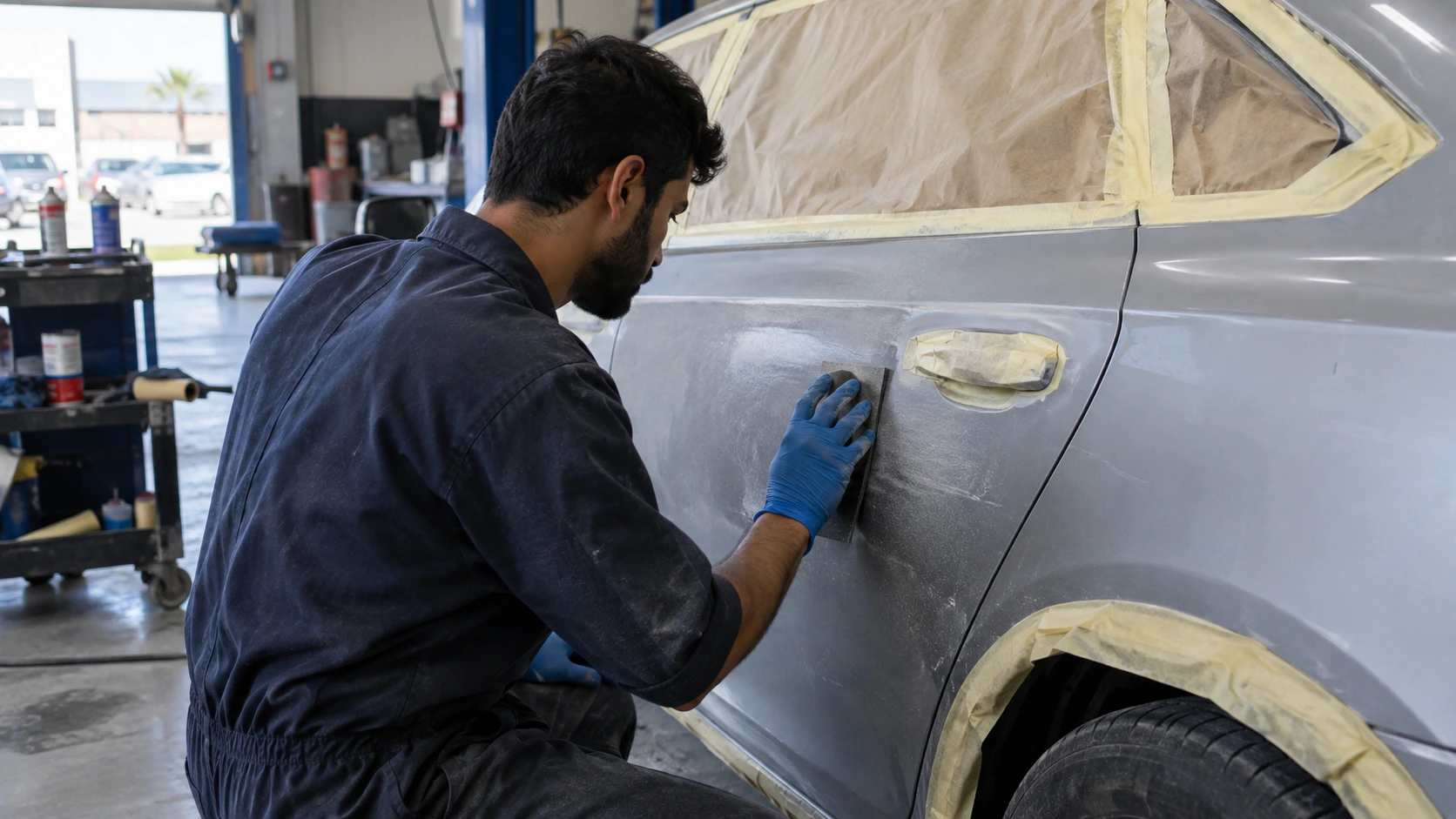
Car paint repair Sharjah can fix scratches, scuffs, chips, peeling patches, and paint damage left by a minor knock. What it costs depends on how deep the damage goes, how big the panel is, and what kind of paint your car has. A surface scratch in the clear coat is a very different job from a dent with cracked paint.
I’ll go through what paint repair can fix, how to judge your own damage, and what affects the price. Jawharat Al Sahil Auto Maintenance is in Al Qassim, Industrial Area 4, and has more than 15 years of experience.
Car Paint Repair Sharjah: What the Workshop Can Fix
Most paint damage falls into a few groups, and each needs a different repair. I would not decide on a fix from one photo or one symptom. The depth of the damage decides the method.
What We Repair
Paint repair at Jawharat Al Sahil Auto Maintenance sits alongside the workshop’s body repair, denting, and painting services, which are part of its wider car repair services in Sharjah.
- Scratches and scuffs: Light marks may only affect the clear coat. Deeper ones reach the color layer, the primer, or the bare metal.
- Bumper scrapes: Parking knocks and kerb contact often scuff the paint and sometimes crack the bumper surface too.
- Dents with paint damage: If the paint has cracked or chipped on a dent, the dent repair and the paint repair usually go together.
- Chips and peeling paint: Small chips can spread if left alone, and peeling paint tends to get worse once the surface layers lift.
- Faded or dull paint: Sun exposure can wear down the clear coat, so the surface looks flat or patchy.
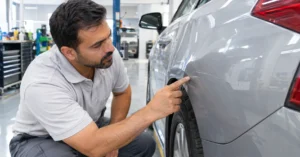
A simple check is to run a fingernail across a scratch. If it doesn’t catch, the damage is often only in the clear coat. If it catches, the scratch has probably gone deeper and needs more than polishing. This is a rough guide, not a diagnosis, and a workshop inspection gives a more reliable answer.
Get a Quote From Photos on WhatsApp
If you’re unsure how serious the damage is, you can send photos on WhatsApp before bringing the car in. A few things help the workshop give a more useful estimate:
- A close-up of the damage and a wider shot of the whole panel
- Photos taken in daylight, without glare on the paint
- The car’s make, model, and year
- Whether the damage came from an accident, a parking scrape, or sun wear
Photos give a first idea of the repair needed. The final price can only be confirmed after the car is inspected in person, because depth, hidden dents, and paint color can change the job once the workshop sees it.
How Sharjah’s Heat and Sun Damage Car Paint
Strong sun and high temperatures wear down car paint from the top. The clear coat takes the damage first, and once it weakens, the color coat underneath starts to fade, chalk, or peel. A car parked outdoors through a UAE summer faces this every day, which is why roofs, bonnets, and boot lids often look worse than the side panels.
The damage builds slowly, so most drivers notice it only when the paint already looks dull. Knowing what causes it makes it easier to slow down and to decide when repair is needed.
UV Exposure and Oxidation
Clear coat is there to protect the color layer. Ultraviolet (UV) light and heat gradually break down its surface. Once that protection thins, the paint beneath is exposed to air and sunlight, and it begins to oxidize. Oxidation is the chemical change that makes paint look chalky, hazy, or washed out.
Heat adds to the problem. Metal panels expand and contract through hot days and cooler nights, and over time this stress can contribute to cracking in an aging clear coat.
Signs I would look for:
- Paint that stays dull even after a wash and wax
- A chalky or powdery feel on the roof or bonnet
- Color that looks lighter on top surfaces than on the doors
- Fine cracks or a cloudy patch in the clear coat
- Red, black, and other dark colors showing the fade first
Horizontal panels get the most direct sun, so check the roof, bonnet, and boot lid first. If the clear coat has started lifting or flaking, that is no longer simple fading. It has become peeling, and the panel will need repainting.
Bird Droppings and Tree Sap
Bird droppings and tree sap are small marks that can do more damage than they look. Droppings can be acidic, and in strong heat they bake onto the surface. If they sit for days, they can etch into the clear coat and leave a dull or cloudy mark that stays after the dropping is removed.
Tree sap hardens in the heat and bonds firmly to the paint. Scraping it off with a fingernail or a sharp tool can scratch the clear coat.
What I would do:
- Remove droppings as early as you can, once the surface is cool.
- Soften them first with a wet, soft cloth or a car-safe cleaner, then lift them away. Wiping a dry dropping can scratch the paint.
- Don’t scrape sap. Use a cleaner made for it, or ask a workshop to remove it.
- If a mark remains after cleaning, polishing may remove light etching. Deeper etching may need a repaint of the area.
Outdoor vs. Covered Parking
Where you park changes how fast the paint ages. A car in a covered or shaded spot sees far less direct UV and heat than one left in an open car park all day. That makes a visible difference over a few years, especially on dark colors.
Practical steps that help:
- Park in covered or shaded spaces when you can, especially in summer.
- Use a breathable car cover if you must park outdoors. A cover that traps dirt or sits loose and flaps can scratch the paint, so only use one that fits.
- Wash the car regularly. Dust and grime left on the surface can scratch paint when wiped.
- Wax or sealant adds a thin protective layer, though it wears off and needs redoing. It slows damage but doesn’t stop it.
Can Sun-Damaged Paint Be Repaired?
Sometimes, depending on how far the damage has gone. The question is whether the clear coat is still there.
| Stage of damage | What it looks like | Usual fix |
|---|---|---|
| Early fading | Slightly dull, clear coat still intact | Polishing may restore shine. |
| Moderate oxidation | Chalky or hazy, clear coat thin | Careful polishing, with limits |
| Failed clear coat | Cloudy patches, cracks, flaking | Panel repaint |
| Color layer worn | Faded or uneven color, no gloss | Panel repaint |
Polishing removes a thin layer of clear coat to bring back shine. That works when there is enough left to spare. If the clear coat is already thin, heavy polishing can wear through it and make things worse. I would have the paint inspected before agreeing to aggressive polishing on a badly faded roof or bonnet.
Once the clear coat has failed, no polish or wax will fix it. The panel needs sanding back to a stable surface, then primer, color matching, base coat, and clear coat. That is the same repaint process used for peeling paint.
A workshop can check the condition of the clear coat in person. If you’re unsure, photos of the roof and bonnet in daylight are a good starting point, and a close inspection will confirm the right repair.
Spot Repair, Smart Repair, or Full Panel Respray?
Spot repair fixes only the damaged area. A full panel respray repaints the whole panel, usually from edge to edge. Which one suits your car depends on how large the damage is, how deep it goes, and whether the paint around it is still healthy.
Both can give a good result. The wrong choice shows up later as a patch that doesn’t match or paint that fails again.
When Spot or Smart Repair Is Enough
“Spot repair” and “smart repair” are often used for the same thing: repairing a small to medium area and blending the new paint into the surrounding panel, without repainting the whole panel. The idea is to fix only what’s damaged.
It usually suits damage like this:
- A deep scratch or scuff in one small area
- A few chips in a localized spot
- A bumper scrape, once any plastic damage has been repaired
- A small area of paint damage beside a minor dent
The surrounding paint needs to be in good condition for this to work. Blending depends on the old paint being sound enough to match against. If the clear coat nearby is faded or failing, the new section can end up looking different from the rest.
Color is the other limit. Solid colors are generally easier to blend. Metallic and pearl paints are harder because the effect changes with the viewing angle, so a small repair can show up from certain angles.
When a Full Panel Respray Is Needed
I would lean towards a full panel respray when the damage is too spread out, too deep, or the paint is no longer stable. Typical cases are
- Peeling or flaking paint, where the loose layers need to come off
- A failed clear coat, such as cloudy patches, cracks, or sun-faded paint
- Damage across much of one panel, or several separate marks on the same panel
- A previous repair that has faded, lifted, or never matched
- Deep dents that have cracked the paint over a large area
A full panel respray also gives a cleaner finish because the new paint meets the next panel along a natural edge, such as a door gap or body line, where the join is hard to see. Spot repair has to hide the blend inside the panel itself.
It takes more work and usually costs more than a small repair. If the damage is small and the paint around it is healthy, it may be more than you need.
When Paint Repair Isn’t the Right Fix
Sometimes paint isn’t the real problem, and a repair would only cover it up. Have the car inspected first if you notice any of these:
- Rust under or around the damage. Bubbling paint, brown staining, or flaking edges can mean rust is spreading beneath the surface. Repainting over it without treating the rust properly lets it come back.
- creased, bent, creased, or misaligned panel. The panel may need straightening before any paint goes on.
- A cracked or loose bumper. The plastic needs repairing or replacing first, and there may be damage behind it that you can’t see.
- Marks that aren’t actually paint damage. Tar, tree sap, water spots, and paint transfer from another car can look like scratches. Some can be cleaned or polished away without repainting.
This is why I would not book a respray from a photo alone. A close look shows whether the problem is in the paint or underneath it.
Dent Plus Paint Damage vs Paintless Dent Repair
Paintless dent repair (PDR) removes a dent by working the metal back into shape from behind the panel, without sanding or repainting. It only works when the paint hasn’t been damaged.
| Situation | Usual approach |
|---|---|
| Dent with intact, uncracked paint | Paintless dent repair may be possible |
| Dent with cracked, chipped or scratched paint | Dent repair plus repaint |
| Sharp crease or a dent on the panel edge | Often needs conventional repair |
| Very deep or stretched metal | Often needs conventional repair |
If the paint has cracked, PDR can’t fix that part, and the exposed area needs repainting. Whether PDR is possible also depends on where the dent is and whether the back of the panel can be reached. I would treat any “yes” or “no” without an inspection as a guess.
Quick Comparison
| Damage type | Best fix | Typical time |
|---|---|---|
| Small scratch or scuff in one area | Spot or smart repair | Shorter job |
| A few chips on one panel | Spot repair, or panel repaint if widespread | Shorter to medium |
| Bumper scrape, no cracks | Spot or smart repair | Shorter to medium |
| Peeling or flaking paint | Full panel respray | Longer job |
| Failed clear coat or sun damage | Full panel respray | Longer job |
| Dent with intact paint | Paintless dent repair, if suitable | Depends on the dent |
| Dent with cracked paint | Dent repair plus repaint | Longer job |
| Rust under the paint | Rust treatment, then repaint | Depends on the spread |
Time depends on the car, the paint type and how busy the workshop is, so a firm estimate comes only after inspection.
How Our Car Paint Repair Process Works
A good paint repair is mostly preparation. The spraying is the short part. Most repairs that fail later, with paint lifting, a patch that doesn’t match, or sanding marks showing through, fail because of a rushed step before the paint went on.
Here is the order a proper repair follows, from first look to handover. Jawharat Al Sahil Auto Maintenance works in four stages: contact, inspection and diagnosis, a clear quote you approve, and a quality check before the car goes back to you. The steps below fill in what happens inside those stages.
Inspection and Diagnosis
The repair starts with a close look at the damage in good light. The aim is to find out what is actually wrong before deciding how to fix it.
The inspection checks:
- Depth: whether the damage is in the clear coat, the colour coat, the primer or the bare metal
- Size and spread: one mark or several, and whether they sit on one panel or more
- Condition of the surrounding paint: whether it is sound enough to blend into
- Hidden problems: rust starting under the paint, a dent behind the scratch, or a cracked bumper mount
I would not skip this step or settle it from photos. A scratch that looks minor can sit on a panel with a small dent behind it, and that changes the job.
Clear Quote Before Work Starts
After the inspection, the workshop explains what it found and what repair it recommends. You get a quote and decide whether to go ahead. On Jawharat Al Sahil’s process, work starts only after you approve it.
Ask what the quote covers. It should tell you which panels are included, whether any dent or plastic repair is part of it, and whether any extra work could appear once the panel is stripped back. If the price depends on something that can’t be seen until sanding starts, a good workshop says so up front.
Surface Prep and Sanding
This step takes the most care. Paint only holds on a surface that is clean, smooth and properly keyed, which means lightly roughened so the new layers can grip.
Prep usually involves:
- Cleaning the area to remove wax, grease, dirt and polish residue
- Sanding the damaged area back until the edges of the scratch or chip are smooth, and feathering the edges so no hard line shows under the new paint
- Treating any exposed metal and repairing any dent, crack or gouge
- Masking the surrounding trim, glass and panels so overspray doesn’t land on them
Careful sanding is why a repair looks flat and even when finished. Rushed sanding often shows up weeks later as visible edges or lifting paint. This is also where a bad earlier repair gets found, since poor prep underneath is a common reason repainted panels peel.
Colour Matching Using Your Paint Code
Every car has a manufacturer’s paint code, usually printed on a compliance plate or sticker. Common spots are the door jamb, under the bonnet or in the boot area, though the location varies by make. The code gives the colour formula the paint was originally mixed to.
The code is a starting point, not the full answer. Paint changes with age. A car that has spent years in strong sun has faded slightly, so a fresh mix from the original formula can look a shade off next to the old paint. That is why a repair is usually tested against the car and adjusted, and why blending (covered below) matters.
Metallic and pearl colours need extra care, because the effect shifts with the angle of the light. A match that looks right straight on can look different from the side.
If you can find your paint code, send it along with your photos. It helps, but the workshop will still check the colour against the car.
Primer, Base Coat and Clear Coat
New paint goes on in layers, each with a job.
- Primer: goes onto bare metal or repaired areas. It helps the paint grip and protects the metal from moisture. Light sanding often follows to leave a smooth surface.
- Base coat: the coloured layer, applied in thin coats until the colour covers evenly.
- Clear coat: the protective top layer that gives the gloss and shields the colour from UV light and everyday wear.
Each layer needs time to dry or flash off before the next goes on. Rushing that makes the paint lift, run or stay soft. I would be wary of any repair promised in a very short time, because paint that hasn’t cured properly can mark easily and fail early. Ask the workshop how long the car should be left before washing or waxing.
Blending, Polishing and Quality Check
The last stage is where the repair stops looking like a repair.
Blending feathers the new colour and clear coat into the surrounding paint so there’s no visible edge. On a spot repair, the blend zone does the hiding. On a full panel respray, the panel’s natural edges do it.
Polishing comes after the paint has cured. It levels any slight texture in the clear coat and brings the gloss up to match the rest of the car.
Quality check: before the car is handed back, the repair should be looked over in good light and from different angles, which is the best way to spot colour differences, dust specks or uneven gloss. You can do the same at handover:
- Look at the panel in daylight, not only under workshop lights
- Check from several angles, especially on metallic colours
- Run a hand over the repair to feel for rough spots
- Compare the gloss with the panel next to it
Point out anything that looks wrong at handover. It is much easier to raise it then than weeks later.
Car Paint Repair Cost in Sharjah
The cost of car paint repair in Sharjah depends mainly on how deep the damage goes and how much of the car needs work. A light scratch that only needs polishing costs far less than a deep scratch, a bumper repaint or a full panel respray. A fixed price from a photo is a guess, and the real figure comes after inspection.
Below is what moves the price up or down, where to add your own figures, and how to compare quotes without being caught out.
What Decides the Price
Five things affect almost every paint repair quote:
- Damage depth: A clear coat scratch needs less work than one that reaches the primer or bare metal. Deeper damage needs sanding, primer, colour and clear coat, and each stage adds labour and materials.
- Panel size: Repairing a door or bonnet takes more paint and time than a small area on a mirror cap or bumper corner.
- Metallic or pearl paint: These colours are harder to match and blend, because the finish changes with the viewing angle. They usually take more time than a solid colour.
- Number of panels: One panel is one job. Several panels mean more prep, more masking and more matching, though some steps can be shared between them.
- Car make and model: Some paints cost more or are harder to match, and some panels are harder to remove and refit. Bumpers with sensors or cameras may need extra care.
Hidden damage can also change a quote. Rust under the paint, a dent behind the scratch or a cracked bumper mount often only shows once the area is prepared. Ask whether the quote covers that kind of extra work or whether it would be priced separately.
Typical Prices by Damage Type
I don’t have verified price data for this workshop, so I have left the figures blank. Fill in your own ranges before publishing, and only include numbers you are ready to honour.
| Damage type | Price depends on | How to get your price |
|---|---|---|
| Light scratch (polishing) | Size of the area, condition of the clear coat | Send photos on WhatsApp |
| Deep scratch (one area) | Depth, size, paint type | Send photos on WhatsApp |
| Paint chips (small cluster) | Number of chips, panel | Send photos on WhatsApp |
| Bumper scrape or scuff | Plastic damage, sensors, paint type | Send photos on WhatsApp |
| Single panel respray | Panel size, metallic or pearl paint | Inspection, then a quote |
| Dent plus paint repair | Dent depth, paint damage, panel | Inspection, then a quote |
| Faded roof or bonnet | Panel size, clear coat condition | Inspection, then a quote |
If you prefer not to publish fixed numbers, “starting from” figures also work, or a line such as “Prices depend on inspection” under the table. Keep the table consistent with what you actually charge, because people will quote it back to you.
Why the Cheapest Quote Can Cost More Later
Many drivers look for affordable car paint repair, and that is reasonable. The risk is a very low quote that gets there by skipping steps. Sanding, primer and curing time are the usual ones, and you can’t see them when the car comes back. The problems show up weeks or months later:
- Paint that lifts or peels at the edges of the repair
- A patch that doesn’t match once the sun hits it
- Sanding marks or a rough texture showing through the clear coat
- Dull clear coat that fades faster than the paint around it
Fixing a failed repair usually costs more than doing it properly the first time, because the bad paint has to be removed before the new work starts. I would compare quotes by what is included, not only the total. Ask:
- Which panels and which steps does the price cover?
- Does it include colour matching and blending, or only spraying?
- Could the price change once the panel is prepared?
- Is there any warranty on the repair, and what does it cover? (Only mention this if you offer one.)
A quote that explains its steps is usually easier to trust than one that gives only a number.
How to Get an Exact Price From Photos
Photos give a good first idea, and Jawharat Al Sahil Auto Maintenance accepts them on WhatsApp at +971 52 207 4594. The final price is confirmed after the car is inspected, since depth, hidden dents and colour can change the job.
To get the most useful estimate:
- Send a close-up of the damage and a wider shot of the whole panel.
- Take the photos in daylight, away from glare and reflections.
- Include the make, model and year of the car.
- Say how the damage happened: a parking scrape, an accident, or sun wear.
- Mention anything you’ve already tried, such as polish or touch-up paint, since it can affect the repair.
- Send your paint code if you can find it.
Expect a range or a first opinion from photos, not a guaranteed final price. If the workshop gives a firm figure without seeing the car, ask what it is based on.
Pickup Service for Your Car
If you can’t bring your car to the workshop, you can ask for a pickup. Your car is collected and taken to the workshop for inspection and repair. The repair is done at the workshop, not at your home or office, so this is not mobile car paint repair.
How to Request a Pickup
Jawharat Al Sahil Auto Maintenance has a pickup request form on its website. The form asks for:
- Your name
- Your email
- Your phone number
- The date you want the car collected
- The pickup time
You can also contact the workshop on WhatsApp at +971 52 207 4594 before you fill in the form. A few details make the request easier to handle:
- Where the car is located and how to reach it
- The make, model and year
- A short description of the paint damage, with photos if you have them
- Whether the car is driveable
Ask the workshop to confirm the pickup details, including the date, time and any charge, before the car is collected. Your website doesn’t state whether pickup is free or paid, or which areas it covers, so don’t assume either. Photos sent in advance also let the workshop give you a first idea of the repair, with the final quote confirmed after inspection.
Car Makes We Repair
I would check that your car’s make is covered before you book, since paint matching and panel work vary between brands. Jawharat Al Sahil Auto Maintenance repairs a range of everyday and premium makes, including:
- Toyota
- Nissan
- Honda
- Hyundai
- Kia
- Ford
- BMW
- Mercedes
- Audi
- Lexus
- Mitsubishi
- Chevrolet
If your car isn’t on this list, send the make, model and year on WhatsApp and ask whether the workshop can take it.
Some cars need extra care for paint work. Metallic and pearl finishes, common on many premium models, are harder to match and blend. Bumpers with parking sensors or cameras need careful handling during removal and refitting. Mention these details when you ask for a quote so the estimate reflects them.
Caring for Freshly Repaired Paint
New paint looks finished when you collect the car, but it may not be fully cured. Paint hardens in stages, and the first days and weeks are when it is easiest to mark. How long that takes depends on the paint system and the workshop’s process, so ask your painters for their waiting times at handover instead of relying on a general figure.
Questions worth asking at handover:
- How long before I can wash the car?
- How long before I can wax or polish the repaired area?
- Is there anything I should avoid in the first few weeks?
Washing and Parking After Repair
Until the workshop tells you the paint is ready, I would treat the repaired area gently. General guidance that applies to most fresh paint:
- Hold off on washing until your painters say it is safe. Ask for the exact wait.
- Avoid automatic car washes with brushes at first. Brushes can scratch or mark paint that hasn’t fully hardened.
- Skip pressure washers on the repaired area until you have the go-ahead. A strong jet near the edge of new paint can lift it.
- Wash by hand with a clean, soft cloth or mitt and a car-safe shampoo once you are cleared to wash.
- Don’t wax or polish the new area until the workshop confirms. Wax can trap solvents that are still leaving the paint.
- Remove bird droppings, sap and dust gently. Soften them with a wet cloth first, and don’t scrub dry.
- Avoid parking under trees, near construction or beside loose gravel where you can, since fresh paint marks more easily.
Check the repair again after the first few washes. If you see lifting edges, bubbles, a patch that looks different in the sun, or a dull spot, contact the workshop sooner rather than later. Raising it early is easier than waiting months.
Protecting Paint From Sharjah Sun
Strong sun and heat wear down all paint, and new paint is no exception.A repaired panel will age under the same UV exposure as the original. Paint makers and car manufacturers both note that UV and heat can break down a car’s clear coat, so protecting the repair helps it last and keeps the colour even.
- Park in shade or covered parking when you can, especially in summer. The roof and bonnet take the most direct sun.
- Wash the car regularly so dust and grime don’t build up and scratch the surface when wiped.
- Apply wax or a paint sealant once the workshop says the paint is ready. It adds a thin protective layer, but it wears off and needs redoing.
- Use a car cover only if it fits well and the paint is clean. A loose cover can flap and scratch, and a cover over a dirty car grinds grit into the finish.
- Ask about protective options if you want extra UV protection, but only buy what you understand and need.
Sunshades inside the car help the interior, but they do little for the paint, so don’t count them as paint protection.
How to Choose a Car Paint Shop in Sharjah
Sharjah has many workshops that offer paint repair, and the quality varies. Price alone is a poor guide, because a low quote can come from skipped steps that only show up later. This checklist helps you compare shops on things you can check.
Checklist for Choosing a Paint Shop
- A written quote that lists what’s included. It should say which panels are covered, which steps are included (prep, primer, colour matching, clear coat, polishing) and whether extra work could be added after the panel is prepared. A figure with no detail is hard to compare.
- A clear explanation of the damage. A good workshop tells you what is wrong in plain words and why it recommends a given repair. Be careful with anyone who quotes a major repair without looking at the car.
- Colour matching that is tested, not assumed. Ask how the colour will be matched and checked against your car, especially for metallic or pearl paint.
- Before-and-after photos of real jobs. Look for close-ups in daylight, similar damage to yours, and several angles. A few good photos say more than a long list of claims.
- Real reviews. Read Google reviews for specifics: paint quality, matching, timing and how the shop handled problems. Look at recent reviews, and be wary of a profile with only generic praise or a sudden burst of similar reviews.
- Warranty or aftercare terms, if offered. If a warranty is mentioned, ask what it covers and for how long, and get it in writing. If none is offered, that’s worth knowing before you decide.
- A proper inspection before the final price. Shops that confirm a firm price from photos alone may change it later.
- A visit to the workshop. See how the cars are handled, how tidy the work area is and whether they explain their process.
Compare at least two shops on these points rather than only the lowest number. The right one is usually the shop that tells you clearly what the repair needs and what it includes.
Car Paint Repair in Sharjah: Frequently Asked Questions
How much does car paint repair cost in Sharjah?
It depends on damage depth, panel size, paint type and the number of panels. A reliable price comes only after inspection, so send photos on WhatsApp for a first idea.
How long does a paint repair take?
A small spot repair is quicker than a full panel respray, and dent, plastic or rust work adds time. Ask for a time estimate with your quote and confirm it after inspection.
Will the new paint match my original colour?
A close match is the goal, but paint fades with age, so the mix is tested and blended against your car. Check the finished repair in daylight and from several angles.
Can sun-faded paint be restored?
Sometimes. If the clear coat is still in place, polishing may bring back some shine. If the clear coat has cracked, turned cloudy or started flaking, polishing can’t fix it, and the panel usually needs repainting. Heavy polishing on thin clear coat can wear through it, so have the paint checked first.
How much does a bumper repaint cost?
The price depends on the type of damage, the paint colour, and whether the bumper has cracks or gouges that need repairing first. Parking sensors or cameras can add work, since the bumper may need to be removed and refitted carefully. A light scuff costs less than a cracked bumper that needs plastic repair before painting.
Send photos of the bumper on WhatsApp with your car’s make, model and year for a first idea, and expect the final figure after inspection.
Get Your Free Car Paint Repair Quote
If you’re not sure what your paint needs, the quickest start is to send photos. Take a close-up and a wider shot of the damage in daylight, and add your car’s make, model and year. The workshop will tell you what repair it thinks is needed and will confirm the price after inspecting the car. Work starts only after you approve the quote.
Jawharat Al Sahil Auto Maintenance
Al Qassim, Industrial Area 4, Sharjah, UAE
Map location: 8CCQ+63W, Sharjah
Phone / WhatsApp: +971 52 207 4594
Email: jawharatalsahil631@gmail.com