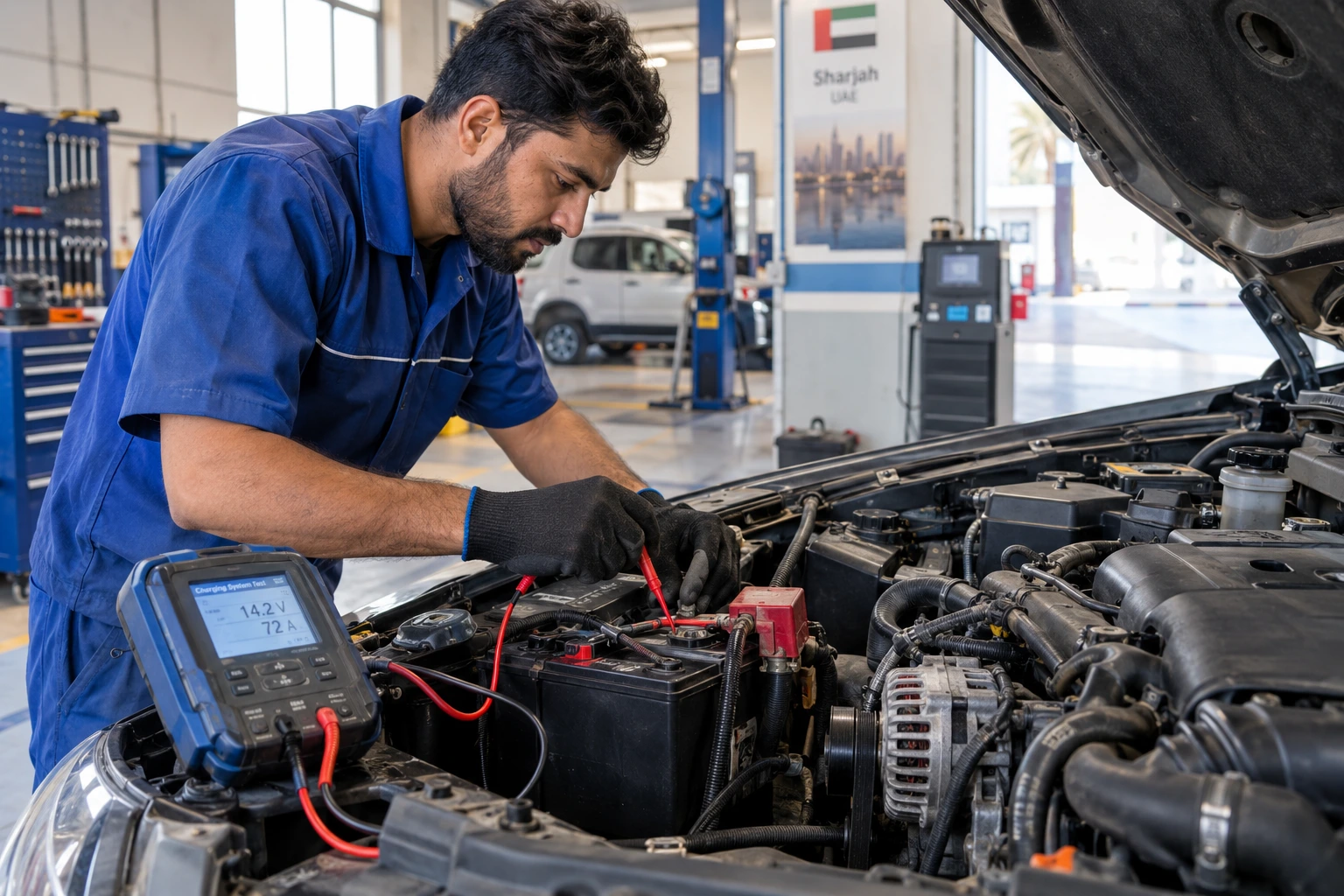
Battery light on your dashboard? The car won’t start in the morning? Headlights dimming while you drive? Your alternator might be failing. The alternator is the heart of your car’s electrical system—without it working properly, your battery drains, your car loses power, and you risk being stranded on the road in Sharjah’s heat. This guide explains what your alternator does, how to recognize when it needs repair, how we test the charging system to find the real problem, and what your repair options actually are. Read on to understand your alternator and know exactly what to do next.
1: CAR ALTERNATOR REPAIR IN SHARJAH: WHAT OUR WORKSHOP DOES
The alternator is an electrical generator bolted to your engine. As the engine runs, the alternator converts mechanical energy into electrical power. This power charges your battery and supplies electricity to your car’s lights, air conditioning, power windows, stereo, and all other electrical systems.
When the alternator fails, your car runs on battery power alone. A car battery can power an engine for only 5–30 minutes before it drains completely. After that, the engine stalls, your power steering goes heavy, your brakes become hard to press, and your headlights die. You are stranded.
At Jawharat Al Sahil Auto Maintenance, we do not guess. We test. Every alternator problem begins with a complete charging system diagnosis. We measure what is actually happening in your electrical system, identify exactly which component has failed, and recommend only the repair or replacement that makes sense for your car and your budget.
Rather than pushing you to buy a new alternator, we find out if the real problem is a loose battery connection, a worn belt, a faulty voltage regulator, or something else entirely. Sometimes the fix is simple and cheap. Sometimes the alternator truly needs replacement. Our job is to tell you the truth.
Alternator Output and Charging Voltage Testing
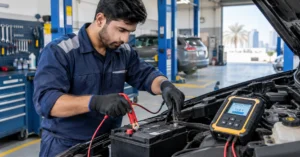
I always start with a charging system test. This is not a guess—it is a measurement using proper diagnostic equipment.
We check:
• Battery voltage at rest (should be 12.6 volts or higher)
• Battery voltage with the engine running (should be 13.5 to 14.5 volts)
• Alternator output current (how much power the alternator is actually producing)
• Voltage regulation (whether the alternator holds steady charging voltage)
If battery voltage drops below 12 volts at rest or falls when you turn on headlights and accessories, the alternator is not charging properly. If the engine is running but battery voltage stays at 12 volts or below, the alternator output is too low. This confirms an alternator fault, not just a battery problem.
This test takes 10–15 minutes and saves you from replacing a good battery or buying an unnecessary alternator. We have seen drivers replace a battery twice because another workshop never tested the alternator. They kept installing new batteries that would not stay charged because the alternator was never working to begin with.
Alternator Repair: Regulator, Diode, Bearing, and Pulley Faults
Not every alternator fault requires replacement. I inspect the alternator for specific internal failures that can be repaired:
Voltage Regulator Failure
The voltage regulator controls how much current the alternator produces. If it fails, the alternator either overcharges (damaging the battery) or undercharges (leaving the battery drained). A faulty regulator can sometimes be replaced without replacing the entire alternator, saving significant cost.
Diode Failure
Alternators contain diodes—electrical one-way valves. If a diode fails, the alternator cannot convert AC current to DC current properly, and charging voltage drops. Diode replacement is internal work that requires skill, but it costs far less than a new alternator.
Worn Bearings
The alternator shaft spins on bearings. Worn bearings create a whining or grinding noise and can cause internal damage. Once bearings wear severely, the alternator must be replaced, but catching bearing wear early can sometimes extend the alternator’s life by months.
Pulley Wear or Slipping
The serpentine belt drives the alternator pulley. If the pulley is worn or the belt slips, the alternator cannot spin fast enough to produce full output. This creates an undercharging condition that feels like alternator failure but is actually a belt or pulley problem.
When I find these specific faults, I explain whether repair is practical or replacement makes more sense. Not every workshop takes time for this diagnosis. Many simply recommend replacement and move on. I do not.
Drive Belt and Belt Tensioner Check
The serpentine belt transfers engine power to the alternator. A loose, cracked, or frayed belt reduces alternator speed and prevents full charging. A worn belt tensioner allows the belt to slip, starving the alternator of engine speed.
As part of alternator diagnosis, I inspect the belt and tensioner. If the belt is worn but the alternator itself is fine, we replace the belt. If the tensioner is weak, we replace that. This step prevents misdiagnosis and saves unnecessary alternator replacement.
A visual belt check takes seconds but reveals everything. I look for:
• Visible cracks or fraying across the belt surface
• Glazing (shiny, slippery surface that loses grip)
• Improper tension (the belt should move no more than half an inch when pressed firmly)
• Tensioner noise (clicking or rattling when the engine runs)
2: SIGNS YOUR CAR ALTERNATOR NEEDS REPAIR IN SHARJAH
The alternator fails gradually in most cases. You will notice warning signs before the car stops completely. Learning to recognize these signs helps you get to a workshop before you are stranded on the side of the road.
Battery Warning Light on the Dashboard
The alternator warning light (usually a battery symbol) illuminates when the charging system voltage drops below 12.5 volts. This is not a battery light—it is a charging system light. It means the alternator is not maintaining proper voltage to charge the battery.
I see drivers ignore this light for weeks, thinking it will go away on its own. It does not. The light is your car telling you the battery is discharging, not charging. Every day you drive with this light on, the battery loses more charge. Eventually, you won’t have enough power to start the engine.
This light appears because:
• The alternator is not producing enough voltage.
• The serpentine belt is too loose.
• A battery connection is corroded or loose
• The voltage regulator has failed.
• The alternator bearings are worn.
The light tells you a fault exists. Only a proper test identifies which fault it is.
Dim, Flickering, or Pulsing Headlights
When the alternator cannot supply steady power, lights flicker or dim as electrical load changes. Turn on the air conditioning, and lights dim noticeably. Turn it off, and lights brighten. This pulsing happens because the alternator output is unstable.
Headlight brightness should stay constant whether the AC is running or not. If it changes with engine load, charging system voltage is unstable. This typically means:
• Alternator output is low.
• Battery connections are corroded or loose.
• The battery itself is weak and cannot stabilize voltage.
• The voltage regulator is not controlling output properly.
Flickering headlights are dangerous—they reduce visibility at night and make other drivers less likely to see you. Do not ignore this symptom. It often appears before the car fails to start.
Whining or Grinding Noise from the Engine Bay
A high-pitched whining sound from the alternator area suggests worn bearings. The alternator spins at speeds up to 6,000 RPM. Worn bearings create friction, which produces noise.
A grinding noise is more serious. It often means the bearing is about to fail completely. When this happens, the alternator pulley can seize, breaking the serpentine belt and leaving you with no charging and no power steering (if your car uses a belt-driven pump).
I never ignore bearing noise. If you hear whining or grinding from the engine area, have the alternator inspected immediately. Waiting often results in a breakdown on the road.
Car Won’t Start or Starts Then Stalls
If the battery is too low to crank the engine, the starter motor turns slowly or not at all. The engine cranks weakly, takes longer than usual to fire, or does not start at all.
Even if the car does start, it may stall while driving. This happens because without alternator charging, the battery voltage drops too low to power the ignition system. The engine dies, and you lose power steering and braking assistance (if hydraulic assist fails).
This is dangerous. Do not attempt to drive a car that stalls unexpectedly. Have it towed to a workshop for diagnosis.
Burning Smell, Electrical Faults, and Weak Power Windows
If the alternator overcharges (producing more than 14.5 volts), the excess current damages the battery, electrical components, and wiring. A burning smell from the engine area or battery area indicates overcharging.
You might also notice:
• Power windows move slowly or stop working
• Dashboard lights behave erratically.
• The sunroof opens or closes slowly.
• Audio system cuts out or crackles
• Air conditioning compressor stops engaging
All of these are signs of unstable or low charging voltage. The battery cannot supply enough current to power everything at once.
Battery Keeps Dying Even After Charging or Replacement
Many drivers experience this: they charge or replace the battery, and two weeks later it is dead again. They bring the car to another workshop; the battery tests fine, but the problem returns.
This is almost always an alternator problem, not a battery problem. The battery is fine—it just cannot stay charged because the alternator is not charging it. Replacing the battery twice does not fix the alternator.
If your battery drains repeatedly, do not keep replacing it. Get the charging system tested. Ninety percent of the time, the alternator is the real problem.
3: ALTERNATOR OR BATTERY? HOW WE TEST YOUR CHARGING SYSTEM
This is the most important section. Many drivers assume a dead battery means the battery failed. Many workshops assume the same and sell replacement batteries unnecessarily. I always test the entire charging system before recommending any parts replacement.
Why a Dead Battery Is Not Always a Battery Problem
A dead battery can result from:
- The battery itself has aged and lost capacity (typical life: 3–5 years)
- The battery terminals are corroded, preventing charging current from flowing
- The battery has an internal short circuit, making it unable to hold a charge
- The alternator is not charging, so the battery drains even though it is healthy
The first three are battery problems. The fourth is not. But they all feel identical to a driver—the car will not start, the lights are dim, and the battery seems dead.
This is why I test before I recommend replacement. I have seen drivers spend 500–800 AED on a new battery, only to return a week later with the same problem. The alternator never charged the new battery either, so it died again.
Testing takes 15 minutes. Replacing a good battery is wasted money.
Step 1: Battery Health and Voltage Test
First, I measure battery voltage with the engine off. A healthy battery should show:
• 12.6 volts or higher at rest (battery fully charged)
• Below 12.6 volts (battery partially discharged)
• Below 11 volts (battery critically low, cannot start the car)
Next, I check how the battery responds when I turn on the headlights and other electrical loads. A good battery holds 10–11 volts even with heavy load. A weak battery drops below 10 volts immediately.
If the battery is below 11 volts, I use a charger to bring it to 12.6 volts. This takes 30 minutes to an hour. Then I proceed to step 2.
Why? Because a discharged battery gives false charging system test results. I need to test with a fully charged battery to get accurate readings.
Step 2: Alternator Output Test with Engine Running
Once the battery is charged, I start the engine and measure:
• Battery voltage with engine running (should rise from 12.6 to 13.5–14.5 volts)
• Alternator amperage output (current flowing from alternator to battery)
If battery voltage stays at 12.6 volts or drops when I turn on headlights and AC, the alternator is not charging. This is a clear alternator fault.
If voltage rises to 13.5–14.5 volts and stays steady, the alternator is charging correctly. If the battery is still dead, the problem is the battery itself, not the alternator. This distinction saves your money.
A good alternator should output 40–150 amperes depending on the car’s electrical demand. If output is below 20 amperes, the alternator is failing. If output is above 15 volts, the voltage regulator has failed and is overcharging.
Step 3: Regulator, Diode, Belt, Wiring and Starter Check
If the alternator test shows low output, I do not automatically recommend replacement. I dig deeper:
• Belt inspection: Is the belt loose, cracked, or slipping?
• Battery connections: Are terminals corroded or loose? Loose connections block charging current.
• Wiring: Are there damaged or corroded wires between the alternator and battery?
• Starter motor load test: Does the starter draw excessive current, overloading the alternator?
• Voltage regulator test: Is the regulator controlling output properly, or is it stuck?
Sometimes the alternator itself is fine, but one of these other components is causing the charging failure. Fixing the belt or cleaning corroded terminals costs far less than replacing an alternator.
Step 4: Computer Diagnostics for Warning Lights
Modern cars have onboard computers that monitor the charging system. If the computer detects a problem, it stores a diagnostic trouble code in memory. This code tells me exactly what the computer detected.
Examples:
• Code P0625: Alternator field control circuit low (regulator failure)
• Code P0626: Alternator field control circuit high (overcharging)
• Code P0633: Insufficient alternator output (low output)
Reading the code eliminates guessing. It points directly to the fault. I then verify the code with physical tests.
The computer sometimes detects problems the driver has not felt yet. For example, early regulator failure might trigger a code before you notice dimming lights. Reading codes early catches problems before they strand you.
Can You Test an Alternator with a Multimeter? What It Shows and Where a Workshop Test Goes Further
A multimeter measures voltage and current. You can use one to check battery voltage and, with skill, alternator output voltage. Many online guides show how to do this at home.
Here is what a multimeter can tell you:
• Is the battery voltage rising when the engine runs? (Yes = alternator is producing some output)
• Is voltage in the normal range (13.5–14.5 volts)? (Yes = charging is probably fine)
Here is what a multimeter cannot reliably tell you:
• Actual alternator amperage output (DIY multimeters often cannot measure this accurately)
• Whether the voltage regulator is failing (early regulator failure shows normal voltage for a while)
• Whether the alternator will fail soon (bearing noise or regulator drift is hard to detect)
• Which internal component has failed (regulator, diode, bearing?)
• Computer diagnostic codes (a multimeter reads no codes)
A multimeter gives you a quick yes-or-no answer: is the car charging? A proper workshop test gives you details: what is charging, how much, and what will fail next?
If a multimeter shows no charging voltage (stays at 12.6 volts with engine running), the alternator is definitely failed. That you can handle yourself. But if voltage is borderline (14.2 volts, or 13 volts, or fluctuating), a multimeter does not tell you if the problem is regulator failure, a bad connection, or alternator output failure. According to automotive electrical experts at YourMechanic, understanding the difference between battery and alternator problems requires professional diagnostic equipment that measures amperage output and voltage regulation under load. This is when workshop diagnostics are worth the cost. We identify the exact fault and explain whether you need repair or replacement.
4: CAR ALTERNATOR REPAIR VS REBUILD VS REPLACEMENT: WHICH IS RIGHT FOR YOUR CAR?
Once I have diagnosed the fault, the next question is always: “Do I need to repair, rebuild, or replace the alternator?”
The answer depends on what has failed, the age of the alternator, and the cost difference between options. I never push replacement if repair is logical.
When Repair Is Enough (Worn Bearing, Faulty Regulator, Loose Connection, Belt or Pulley Fault)
Repair makes sense when the alternator core is healthy but one component has failed:
Loose or Corroded Battery Connections
If the problem is corroded battery terminals or a loose cable, cleaning or retightening costs almost nothing and solves the problem completely. This is a repair, not a part replacement.
Worn Serpentine Belt
A worn belt reduces alternator speed and prevents full charging. Replacing a belt costs 200–500 AED (depending on the car). Replacing an alternator costs 1,500–3,500 AED or more. If the alternator is healthy and the belt is worn, replacing the belt solves the problem.
Belt Tensioner Failure
The automatic tensioner keeps the belt tight. If it weakens, the belt slips. Replacing just the tensioner costs 300–600 AED. This is far cheaper than an alternator.
Voltage Regulator Failure
On some alternator models, the regulator can be replaced separately without replacing the whole alternator. If I find a faulty regulator, I replace it. Cost: 400–800 AED. A new alternator costs more.
Alternator Pulley Wear
The alternator pulley can wear or seize. Sometimes it can be replaced without replacing the entire alternator. Cost: 300–600 AED. Again, much less than a new alternator.
Bearing Wear (Early Stage)
If I catch bearing wear early (noise but no internal damage), lubrication or bearing replacement might extend the alternator’s life another 6–12 months. This buys time if you cannot afford a new alternator immediately.
When any of these faults occur alone, repair is the smart choice. I explain the fault, show you what was wrong, and you leave understanding why the car failed.
When a Rebuilt or Remanufactured Alternator Makes Sense
A remanufactured alternator is a used alternator that has been disassembled, cleaned, tested, and had worn parts replaced. The bearings, brushes, voltage regulator, and diodes are renewed. The core (the main housing and windings) is inspected and reused if it is still good.
Remanufactured alternators cost 30–50% less than new ones. They carry a warranty (typically 12 months). They work as well as new alternators if sourced from a reputable remanufacturer.
I recommend a remanufactured alternator when:
• The alternator has internal damage (burned-out windings, broken diodes, seized bearings) that cannot be repaired
• The cost difference between repair and replacement is small
• You want to reduce costs without sacrificing reliability
• The alternator is older and has reached the end of its practical lifespan
For example, if a 10-year-old alternator has seized bearings, repairing the bearings might buy another 2 years of life, but a bearing replacement costs 600 AED. A remanufactured alternator might cost 1,200 AED and come with a warranty. The extra cost provides longer-term reliability.
Not all situations suit remanufactured parts. If you need certainty that the alternator will last many years, a new alternator is the safer choice. But if budget matters and you are comfortable with a warranty rather than a guarantee, remanufactured saves real money.
When a New Alternator Is the Safer Choice
I recommend a new alternator when:
• The alternator has severe internal damage (catastrophic bearing failure, major winding damage, water damage)
• You want the longest possible lifespan (new alternators typically last 7–10 years)
• The warranty matters (new alternators come with longer warranties, often 3–5 years)
• The car is new or nearly new (you want matching reliability)
• Previous repair attempts failed (if you have already replaced regulator or bearings and the alternator still failed, the core is likely compromised)
A new alternator is the most expensive option but provides the most certainty. You install it and do not think about it for years.
Repair vs Replacement: How We Compare Cost and Reliability for Your Car
Here is my decision-making process:
- Diagnose the exact fault (which component failed?)
- Estimate repair cost (how much to fix just that component?)
- Estimate replacement cost (how much for a new or remanufactured alternator?)
- Assess alternator age (is it 3 years old or 10 years old?)
- Consider warranty needs (does budget or reliability matter more to you?)
- Make a clear recommendation with costs for each option
I present this to the customer before any work starts. I never pressure replacement if repair is practical. I also never recommend cheap, low-quality repairs that will fail again in a month.
The goal is honesty: you understand the options, the costs, and why I recommend one over the others.
Remanufactured vs New Alternator: Price, Warranty and Lifespan Differences
New Alternator
• Cost: 1,500–3,500 AED (depending on car model)
• Warranty: Usually 3–5 years or 100,000 km
• Lifespan: 7–10 years typical
• Advantage: Maximum reliability, longest warranty, brand new components
• Disadvantage: Most expensive option
Remanufactured Alternator
• Cost: 800–1,800 AED (typically 50% less than new)
• Warranty: Usually 12 months
• Lifespan: 5–7 years typical (depends on how well the core was rebuilt)
• Advantage: Significant cost savings, like-new performance if sourced from reputable remanufacturer
• Disadvantage: Shorter warranty, slightly higher risk of needing repair sooner
Used/Pulled Alternator (Not Recommended)
• Cost: 300–600 AED (cheapest option)
• Warranty: Usually none
• Lifespan: Unknown (could fail next week or last 2 years)
• Advantage: Very cheap
• Disadvantage: No history, no testing, high risk of failure, no protection if it dies
I do not recommend used/pulled alternators. You save 200 AED but risk 2,000 AED in labour to install another alternator when this one fails.
For Sharjah drivers, I usually recommend either a new alternator (if budget allows) or a remanufactured alternator from a trusted supplier (if budget is tight). Both provide reliability with proper testing and warranty
5: CAR ALTERNATOR REPAIR COST IN SHARJAH: WHAT AFFECTS THE PRICE
Cost is always a concern. Drivers want to know: how much will this cost? I explain what determines the price so you understand why quotes vary.
What Changes the Price (Fault Type, Parts Needed, Labour Time, Car Make and Model)
Fault Type
• Simple repair (cleaning connections, tightening belt): 100–300 AED
• Belt replacement: 200–500 AED
• Voltage regulator replacement: 400–800 AED
• Bearing replacement: 500–1,000 AED
• Alternator replacement: 1,500–3,500 AED (labour + new part)
A simple connection cleaning is far cheaper than alternator replacement. This is why diagnosis matters—if your fault is a loose terminal, paying for alternator replacement wastes money.
Parts Needed
Different alternators cost different amounts. A Toyota alternator might cost 1,200 AED. A BMW or Mercedes alternator might cost 2,500 AED or more. Luxury and European cars use more expensive alternators.
Remanufactured alternators cost less than new ones (usually 50% of new price). Used alternators cost less still, but carry risk.
Labour Time
Alternator removal takes 1–3 hours depending on the car. Some cars have the alternator in an easy spot (15 minutes to access). Others require removing other components first (AC compressor, intake manifold, etc.). Labour time directly affects labour cost.
Car Make and Model
Japanese cars (Toyota, Nissan, Honda) typically have:
• Cheaper alternators (1,000–1,500 AED)
• Easier access (faster labour)
• Lower total repair cost (1,500–2,500 AED)
European cars (BMW, Mercedes, Audi) typically have:
• More expensive alternators (2,000–3,500 AED)
• Harder access (longer labour)
• Higher total repair cost (2,500–4,500 AED)
This is not inflation—it reflects actual cost differences. European alternators use more advanced regulators and materials.
Repair Cost vs Replacement Cost
Example 1: Worn Serpentine Belt
• Repair cost (replace belt): 250 AED
• Replacement cost (new alternator): 2,000 AED
• Savings with repair: 1,750 AED
Example 2: Faulty Voltage Regulator
• Repair cost (replace regulator): 500 AED
• Replacement cost (new alternator): 2,000 AED
• Savings with repair: 1,500 AED
Example 3: Seized Bearings (Cannot Be Repaired)
• Repair cost: Not possible
• Replacement cost (new alternator): 2,000 AED
• No savings possible
This is why accurate diagnosis saves money. If your alternator has a replaceable part that has failed (belt, regulator, bearing), repair costs a fraction of replacement. If the internal core is damaged, replacement is the only option.
Labour Cost for Alternator Replacement: How It Is Calculated
Labour cost depends on:
• Time to remove the old alternator (access difficulty, bolts, hoses in the way)
• Time to install the new alternator (bolts, connections, belt adjustment)
• Time to test the new alternator (charging test, verification)
• Workshop hourly rate (typically 80–150 AED per hour in Sharjah)
Straightforward removal and installation: 1.5–2 hours × 100 AED = 150–200 AED labour
Complex removal (engine components in the way): 3–4 hours × 100 AED = 300–400 AED labour
Plus diagnostic time if needed: 0.5–1 hour additional
Labour is usually less than the parts cost but still significant. Do not ignore labour when comparing quotes.
Why We Give a Clear Quote Before Any Work Starts
I have seen drivers bring their cars to workshops, have work done, and then receive a bill 50% higher than they expected. This happens when workshops estimate low to win the job, then discover complications mid-work and charge for them later.
I work differently. Before any work starts, I:
- Diagnose the fault (15–20 minutes)
- Calculate the exact parts needed
- Estimate labour time accurately (based on that specific car model)
- Present a clear, itemized quote (parts + labour + diagnostics, if any)
- Explain what the quote covers (what will be done, what will be replaced)
- Get your approval in writing before starting work
If complications arise during work (corroded bolts that are hard to remove, internal alternator damage worse than expected), I contact you and discuss the additional cost before proceeding. You control the decision—you do not discover surprise charges after work is done.
This takes extra time upfront but eliminates conflict later. You know the cost before committing.
How to Compare Alternator Repair Quotes in Sharjah (Honest Advice Builds Trust)
When you get quotes from different workshops, compare these things:
1. What Is Included?
• Does the quote include diagnostics? (If not, add 100–150 AED)
• Does it include a road test after repair? (Good workshops do this)
• Does it include a warranty on parts and labour?
2. What Parts Are Proposed?
• New alternator or remanufactured?
• If remanufactured, from what supplier?
• Are belt and tensioner included, or quoted separately?
3. Labour Time Estimate
• Is it realistic for your car model?
• Does it include testing time?
4. Warranty
• How long is the warranty on the new alternator?
• Does it cover labour if the part fails?
5. Lowest Price = Best Deal?
• Not always. A quote 500 AED cheaper might mean:
- Lower-quality parts
- Shorter warranty
- Skipped testing or verification
- Higher risk of the problem returning
Compare total value, not just price.
Red Flags When Getting Quotes:
• “We cannot give a quote until we remove the alternator” (legitimate workshops can estimate based on diagnosis)
• “Your alternator is definitely bad, buy a new one” (without proper testing)
• “This old belt is dangerous, you need to replace it too” (only if it is actually worn)
• Prices vary wildly (quotes differ by 1,500 AED with no explanation—one is wrong)
Good workshops give transparent quotes. Bad ones pressure you to decide fast without full information.
Get a Free Quote
At Jawharat Al Sahil Auto Maintenance, we provide a free diagnostic inspection and a written quote. You see the problem, understand the solution, and know the cost before we touch your car.
Contact us:
• Phone: +971 52 207 4594
• WhatsApp: +971 52 207 4594
• Location: Al Qassim, Industrial Area 4, Sharjah
We are open Saturday to Thursday. Call or message to book a time that suits you. Diagnostics take 20–30 minutes, and we will have a clear answer for you.
6: HOW LONG DOES ALTERNATOR REPAIR TAKE?
Drivers always ask: how long will my car be in the workshop? Will I get it today or tomorrow? The answer depends on what needs to be done.
Typical Repair Time vs Replacement Time
Simple Repairs
• Cleaning corroded connections or tightening loose terminals: 15–30 minutes
• Replacing the serpentine belt: 45–90 minutes
• Replacing voltage regulator (if accessible): 1–2 hours
• Testing and verification: 15–20 minutes
• Total time: 1.5–3 hours
Simple repairs are often completed the same day. If you bring your car in the morning, it might be ready by afternoon.
Alternator Replacement
• Removing the old alternator (depends on car model): 1–3 hours
• Installing the new alternator: 30–45 minutes
• Reconnecting battery and belt: 15 minutes
• Testing and road test: 20–30 minutes
• Total time: 2–4.5 hours
Replacement usually takes 3–5 hours total, including diagnostics. If you bring your car first thing in the morning, it is often ready by late afternoon or early evening.
Complex Cases
Some cars have the alternator in a tight space. Removing it requires:
• Disconnecting the AC compressor or hoses
• Removing the intake manifold
• Taking off the cooling fan shroud
• Other engine components moved out of the way
These cases might take 4–8 hours and may require overnight work. We would discuss this upfront before starting.
Same-Day Repair: When It Is Possible
Same-day repair is possible for:
• Belt replacement (1.5 hours)
• Connection cleaning or tightening (30 minutes)
• Voltage regulator replacement on accessible alternators (2 hours)
Same-day replacement is possible for:
• Simple alternator swaps on Toyota, Nissan, Honda (3–5 hours)
• European cars with good alternator access (4–6 hours)
If you drop your car off at 8 AM and it is a straightforward replacement, you can usually collect it by 3–4 PM.
Same-day work is not guaranteed—it depends on current workshop load and how complex your specific car is. When you bring your car in, we assess the work and give you a realistic time estimate.
What Can Delay the Job (Part Availability, Hidden Electrical Faults)
Part Availability
If the alternator needs to be ordered, the job takes longer. We keep common alternators in stock (Toyota, Nissan, Honda), but specialty parts might need 1–2 days. We discuss this with you before ordering.
Hidden Electrical Faults
Sometimes the alternator test reveals secondary problems—corroded wiring, a faulty starter motor, battery cell damage. These need attention too, or the car will have electrical problems again soon.
If we discover a hidden fault, we tell you, quote the additional work, and ask if you want it done. This can add 1–2 hours to the job.
Corroded or Stuck Bolts
Old alternators sometimes have bolts that have rusted into place. Removing them takes longer than normal. We use penetrating oil and sometimes heat to loosen them, but this adds 30 minutes to an hour.
Unavoidable Workshop Delays
If the workshop is very busy, your car might wait in the queue. We always prioritize jobs in order received, but peak times (Saturday morning, end of month) can mean waiting 1–2 hours before we start.
Book ahead if you can. Advance booking ensures we have time available for your job.
7: CAN YOU STILL DRIVE WITH A FAILING ALTERNATOR
This is a safety question. Many drivers ask: is it okay to drive the car to a workshop, or should I stop immediately?
The answer depends on how badly the alternator has failed.
How Long the Battery Lasts After the Alternator Fails
Once the alternator stops charging, your car is running on battery power alone. A car battery can power an engine for:
• With no electrical load (just the engine, no lights or AC): 30–45 minutes
• With headlights on: 15–20 minutes
• With headlights, AC, and other devices on: 5–10 minutes
This assumes the battery is fully charged to start with. If the battery is already weak, the time is shorter—sometimes only a few minutes.
You cannot predict exactly how long. The battery might give you 20 minutes or 5 minutes. There is no safe way to know.
Risks of Stalling in Sharjah Traffic and Summer Heat
Stalling Hazard
If the battery drains completely while you are driving, the engine loses ignition power and stalls. You lose:
• Engine power (car slows and stops)
• Power steering (steering becomes very heavy)
• Power brakes (brakes become much harder to press)
• Headlights and dashboard lights (you cannot see)
If this happens in traffic, you are stuck in the middle of the road with a car you cannot easily steer or brake. This is dangerous for you and other drivers.
Summer Heat Risk
Sharjah summers are extremely hot. An engine stalls, and you are stuck on the side of the road with a non-functioning car. While you wait for a tow truck:
• Interior temperature climbs to 50+ degrees
• Air conditioning does not run (engine is off, battery is dead)
• Heat exposure becomes a health risk, especially for children and elderly people
Do not assume you have time to drive to a workshop. You do not.
What to Do If Your Car Warning Light Comes On
If the alternator warning light appears on your dashboard:
1. Do Not Ignore It
The light means the charging system has failed. Drive to a workshop immediately, or if you are far from a workshop, drive to the nearest safe location (gas station, parking area) and call for assistance.
2. Turn Off Unnecessary Electrical Load
• Turn off the AC
• Turn off the radio
• Turn off headlights (if it is daytime and safe to do so)
• Turn off heated seats, rear defogger, any power features
This reduces the electrical load on the battery and gives you a few extra minutes of driving time.
3. Drive Directly to a Workshop
Do not take a long route. Take the shortest route to the nearest workshop. Do not make stops or detours.
4. If the Car Stalls, Call for Help
If the engine dies while you are driving, move the car to the side of the road if it is safe to do so. Turn on hazard lights. Call a tow truck or roadside assistance (such as FIT in the UAE). Do not attempt to restart the engine repeatedly—each attempt drains the battery further.
5. Do Not Keep Restarting a Stalled Engine
Every time you turn the key, the starter motor draws heavy current from the battery. If the battery is nearly empty, restarting multiple times will completely drain it, and the car will not start at all.
Try to start once. If it does not start, stop trying and call for a tow.
Bottom Line: Alternator warning lights are not minor issues. Treat them as urgent. Get to a workshop before the battery completely fails.
8: WHAT CAUSES ALTERNATOR FAILURE IN SHARJAH’S CLIMATE?
Understanding what causes alternator failure helps you prevent problems or catch them early.
Heat and Dust Damage
Sharjah’s climate is brutally harsh on vehicle electrical systems. Summer temperatures reach 50+ degrees. The engine bay temperature can exceed 80 degrees even at idle.
Alternators are metal and electronic components. Extreme heat damages:
• Voltage regulator (electronics degrade in high heat)
• Brushes and bearings (lubrication breaks down)
• Windings (insulation becomes brittle)
• Diodes (heat accelerates failure)
Regular maintenance helps. Ensuring proper engine cooling, keeping the radiator clean, and checking coolant levels reduces alternator temperature stress. Dust is also a problem. Sharjah’s dusty environment means alternators accumulate dust and sand inside. This blocks cooling airflow and causes overheating. Regular alternator cleaning (blowing out accumulated dust) prevents premature failure. Preventive auto car maintenance in Sharjah can catch electrical system problems before they become expensive repairs.
Worn Bearings, Belts and Pulleys
Alternators spin at up to 6,000 RPM. The bearings that support the spinning shaft eventually wear out. Ball bearings have a finite lifespan—typically 5–10 years.
Worn bearings:
• Create noise (whining or grinding sound)
• Reduce efficiency (the alternator spins less smoothly, producing less output)
• Eventually seize (the shaft stops spinning, the belt breaks)
The serpentine belt that drives the alternator also wears. Over 5–7 years, the belt becomes glazed (slippery), develops cracks, or frays. A worn belt slips and cannot transfer full engine power to the alternator.
The pulley groove (which the belt rides in) also wears. A worn pulley causes the belt to slip even if the belt is new.
Regular belt inspection—every 50,000 km—catches wear before failure.
Overloaded Electrical Systems (Audio, Lights, Accessories)
Modern cars have many electrical upgrades:
• High-power audio systems
• LED and HID headlights
• Heated seats
• Panoramic sunroofs with motors
• Adaptive suspension systems
• Multiple USB chargers
Each accessory draws current. The alternator must supply enough power for all of them plus the car’s essential systems. If you add high-power accessories (audio amplifiers, extra lighting) without upgrading the alternator, the alternator becomes overloaded.
An overloaded alternator:
• Works harder, generating more heat
• Fails sooner (fatigue on internal components)
• Never fully charges the battery (demand exceeds supply)
If you upgrade electrical accessories, ensure the alternator can handle the load. Professional installers check this. Amateur installations sometimes overload the alternator without realizing it.
Weak Batteries Overworking the Alternator
A weak or faulty battery makes the alternator work harder. The battery is supposed to smooth out electrical demand—it absorbs excess power from the alternator and supplies power during idle.
A weak battery:
• Cannot accept a charge (internal short circuits block current flow)
• Forces the alternator to compensate by producing higher voltage
• Causes the voltage regulator to work overtime
• Leads to regulator failure and overcharging
A weak battery does not just fail to start the car—it damages the alternator. Replacing the battery sometimes prevents alternator failure.
This is why I always test the battery before recommending alternator replacement. A weak battery can masquerade as an alternator problem.
9: OUR CAR ALTERNATOR REPAIR PROCESS, STEP BY STEP
When you bring your car to Jawharat Al Sahil, here is exactly what happens:
Step 1: Contact Us by Call, WhatsApp or Form
Call or WhatsApp us to describe your problem:
• Phone: +971 52 207 4594
• WhatsApp: +971 52 207 4594
• Email: Through your website contact form
Tell us:
• What symptoms your car is showing (warning light, dim lights, car won’t start, noise)
• What your car make and model is (Toyota, BMW, etc.)
• When the problem started
Based on your description, we estimate how long the work will take and whether we have availability.
If you prefer to bring the car in without calling, that is fine too. Walk-ins are welcome. We assess the problem and give you a time estimate on the spot.
Step 2: Inspection and Diagnosis
We perform a complete charging system test:
• Battery voltage at rest and with engine running
• Alternator output current
• Belt and connection inspection
• Computer diagnostic scan for trouble codes
• Physical inspection of the alternator, bearings, and wiring
This takes 20–30 minutes. We document what we find and show you the results.
We explain what we found:
• “Your battery is healthy, but the alternator is producing only 20 amps. It should produce 80 amps. The voltage regulator has failed.”
• Or: “Your alternator output is normal, but the battery will not hold a charge. The battery has an internal short.”
• Or: “The serpentine belt is cracked and slipping. Replace the belt and your alternator will charge normally.”
You understand the problem and why the solution is needed.
Step 3: Clear Quote, With Work Only After You Approve
We present a written quote that includes:
• What work will be done (specific parts to be replaced or repaired)
• What parts are needed (new alternator, remanufactured alternator, belt, etc.)
• Labour cost (how long it will take, hourly rate)
• Total cost (itemized)
• Warranty (how long the parts are guaranteed)
• Timeline (when the work will be done, when the car will be ready)
You review the quote. If you have questions, we explain further.
You decide:
• Approve the work immediately
• Get a second opinion at another workshop
• Postpone and come back later
We do not start work until you sign the quote and explicitly approve it. No surprises, no hidden charges.
Step 4: Quality Check and Delivery
Once the work is complete, we:
• Test the repair (charging system test to verify the problem is solved)
• Road test the car (drive it to ensure all symptoms are gone)
• Document the work (receipt showing what was replaced, testing results)
• Explain the work to you (show you what was wrong, what was fixed)
You collect the car, and we explain the warranty and any maintenance recommendations.
If a problem reappears during the warranty period, bring it back. We fix it without additional charge.
10: ALTERNATOR PARTS: NEW, REMANUFACTURED AND AFTERMARKET OPTIONS
Many drivers wonder: what types of alternators are available, and which should I choose?
Which Alternator Parts We Can Supply or Source
At Jawharat Al Sahil, we source and install:
• Original Equipment Manufacturer (OEM) alternators: Made by the car’s original manufacturer or approved suppliers (Toyota, Nissan, etc.). Most reliable but most expensive.
• Remanufactured alternators: Used cores rebuilt to like-new condition, with worn parts replaced. Lower cost than new, good quality if from a trusted remanufacturer.
• Aftermarket alternators: New alternators made by third-party manufacturers (not the original maker). Cost less than OEM, quality varies widely.
We do not install low-quality alternators that fail quickly. We source parts from reputable suppliers with track records of reliability.
If you prefer a specific type (OEM, remanufactured, aftermarket), we can source it. Cost and warranty differ, and we explain the tradeoffs.
Original, Aftermarket and Remanufactured: How They Differ
Original Equipment Manufacturer (OEM)
• Made by: The car manufacturer or approved supplier
• Quality: Exact match to the original, highest reliability
• Cost: Most expensive (1,800–3,500 AED)
• Warranty: Usually 3–5 years
• Lifespan: 7–10 years typical
• Best for: Newer cars, luxury vehicles, drivers who want certainty
Aftermarket New
• Made by: Third-party manufacturers (Bosch, Valeo, etc.)
• Quality: Good quality if from established brands, slightly lower reliability than OEM
• Cost: 1,200–2,000 AED (20–30% less than OEM)
• Warranty: Usually 12–24 months
• Lifespan: 6–8 years typical
• Best for: Budget-conscious drivers, older cars where cost matters
Remanufactured
• Made by: Used alternators rebuilt by specialists
• Quality: Like-new if from reputable rebuilder, less certain than OEM
• Cost: 700–1,200 AED (50% less than OEM)
• Warranty: Usually 12 months
• Lifespan: 5–7 years typical
• Best for: Drivers on tight budgets, older cars, willingness to accept a 12-month warranty
Used/Pulled
• Made by: Salvage yards, removed from other cars
• Quality: Unknown (could be nearing failure)
• Cost: 300–600 AED (cheapest option)
• Warranty: Usually none
• Lifespan: Unknown (could fail immediately or last 2 years)
• Best for: Emergency repairs on cars you plan to scrap soon
I do not recommend used/pulled alternators. The savings of 500 AED are not worth the risk of the alternator failing a few weeks later, requiring another installation.
Why We Advise Against Buying Parts Online Without a Proper Diagnosis
Many drivers buy alternators online because the price is cheaper than workshop quotes. This is risky:
Problem 1: You Might Be Buying the Wrong Part
Alternators look similar but are not interchangeable. A Toyota Corolla 2010 alternator is different from a Toyota Corolla 2015 alternator. An online seller might send the wrong part, and you discover this only when the workshop tries to install it.
Problem 2: Online Parts Often Lack Warranty or Support
Online retailers offer low prices because they do not provide support. If the part is defective, returning it is difficult. If it fails after installation, the retailer may refuse a return.
Problem 3: You Still Need Labor and Testing
Even if you buy the part online, you need a workshop to:
• Remove the old alternator
• Install the new one
• Test it
• Ensure it works
Labour and testing cost 400–600 AED. Even with a cheap online part, your total cost is similar to buying from a reputable workshop.
Problem 4: Diagnosis Might Be Wrong
If you buy an alternator without proper diagnosis, you might be replacing a good alternator. The real fault might be a belt, battery, connection, or something else entirely.
Our Recommendation:
Get a diagnosis from a workshop. Once you understand the problem, you can decide:
• Buy the part from us and have us install it (warranty included)
• Buy a part elsewhere and have us install it (warranty on labour only)
• Use our sourced part (highest warranty, best guarantee)
Most drivers choose option 3—they trust us to source a quality part and install it correctly. Cost is similar to option 2, but you get a full warranty.
Cost of a New Alternator for Popular Sedans: Why It Varies by Model
Alternator cost varies because:
Engine Size and Electrical Load
Larger engines with more accessories need higher-output alternators. A Toyota Corolla 1.6L alternator is smaller and cheaper than a Toyota Camry 2.5L alternator.
Car Age
Older cars have simpler alternators. Newer cars have complex regulators, sensors, and electronics. A 2005 Honda Civic alternator costs less than a 2020 Honda Civic alternator.
Vehicle Type
Sedans: Lower output needed
SUVs and Trucks: Higher output needed (more electrical load)
Luxury vehicles: More expensive electronics and materials
Manufacturer
Japanese cars (Toyota, Nissan, Honda): 1,000–1,500 AED
Korean cars (Hyundai, Kia): 900–1,400 AED
European cars (BMW, Mercedes, Audi): 2,000–3,500 AED
American cars (Ford, Chevrolet): 1,200–1,800 AED
There is no single “alternator cost” that applies to all cars. The specific car model determines the cost.
When you get a quote, the alternator price should be specific to your car. If a workshop quotes “1,500 AED for an alternator” without knowing your car model, the quote is not reliable.
11: SHOULD YOU REPLACE AN ALTERNATOR YOURSELF?
Some drivers ask: can I replace the alternator myself and save labour cost?
The honest answer is: probably not, and you should not try.
Why DIY Alternator Replacement Often Goes Wrong (Electrical and Battery Risks, Belt Tension, Wrong Diagnosis)
Electrical and Battery Risks
Removing and installing an alternator involves working with high-voltage electrical connections. If you disconnect a live battery terminal incorrectly, you risk:
• Electrocution (unlikely but possible)
• Short circuits that damage the car’s computer
• Damage to other electrical components
• Fire risk if connections are loose
Proper procedure requires disconnecting the negative battery terminal before work starts. Even then, residual power can cause shocks.
Belt Tension Is Critical
The serpentine belt must be tensioned precisely. Too loose, and the alternator does not spin fast enough to charge. Too tight, and you damage the alternator bearings, causing early failure.
Getting belt tension right requires a tension gauge or deep experience. Installing too-tight belts is a common DIY mistake that damages the new alternator within weeks.
Easy to Disconnect the Wrong Wires
Alternator connectors look similar. Connecting them backward can destroy the voltage regulator instantly. The alternator will not work, and you will have spent 1,000 AED on a new alternator for nothing.
Removing the Wrong Bolts Can Damage the Engine
Some bolts near the alternator are for the engine block or other components. Remove the wrong ones, and you can cause oil leaks or damage engine mounts.
Wrong Diagnosis Leads to Replacing a Good Alternator
Many DIY replacements happen because the driver assumes the alternator is bad without testing. The real fault was the battery, a loose connection, or a worn belt. Installing a new alternator does not fix the real problem.
You End Up at a Workshop Anyway
If something goes wrong during DIY replacement, you end up bringing the car to a workshop. The workshop charges to diagnose what went wrong, remove your incorrect installation, and do the job properly. Total cost is often more than if you had come to a workshop initially.
When It Is Better to Bring Your Car to a Workshop
Alternator replacement requires:
• Proper tools (socket sets, belt tensioner tool, connector removal tools)
• Technical knowledge (knowing which bolts to remove, which wires to disconnect)
• Testing equipment (to verify the repair is correct)
• Warranty (if something goes wrong, the workshop is responsible)
Bring your car to a workshop. You get:
• Correct diagnosis (testing the whole charging system, not just guessing)
• Professional installation (with tools, knowledge, and care)
• Warranty (if the alternator fails within the warranty period, we fix it free)
• Time savings (a professional does it faster than you will)
• Peace of mind (if something is wrong, you have recourse)
Labour cost (400–600 AED) is well worth the risk avoidance.
12: MOBILE AND PICKUP ALTERNATOR REPAIR IN SHARJAH
Some drivers ask: can you come to my location, or do I need to bring my car to the workshop?
Request Pickup for Your Car
We offer pickup service for customers in Sharjah. If your car is immobile (will not start, cannot be safely driven), we can arrange pickup and drop-off.
How Pickup Works:
- Call or WhatsApp us describing the problem
- We assess whether we can safely tow your car
- We arrange a convenient time for pickup
- Our team collects your car from your location
- We perform diagnosis and repair at our workshop
- We deliver the car back to you once work is complete
Pickup Service Coverage:
We service Sharjah areas. For locations outside Sharjah or far from Al Qassim Industrial Area, we can discuss options.
Cost:
Pickup and drop-off service may incur a small fee depending on distance. We discuss this when you call.
H3: Mobile or At-Home Alternator Repair
For complicated alternator repairs, tools and equipment must be available. Most alternator work requires:
• Vehicle lift or ramps (to access the alternator safely)
• Proper lighting (to see what you are doing)
• Testing equipment (to verify the repair)
• Safe disposal of old parts
These are available in a workshop but not typically at a customer’s home or roadside.
For this reason, we perform alternator repair and replacement at our workshop, not at your location.
If your car breaks down on the road, we can arrange towing to our workshop, where repairs are done properly.
Visit Our Workshop in Al Qassim, Industrial Area 4
Our workshop is located in Al Qassim, Industrial Area 4, Sharjah. This is central and accessible from most of Sharjah.
Address: Al Qassim, Industrial Area 4, Sharjah, UAE
Contact:
• Phone: +971 52 207 4594
• WhatsApp: +971 52 207 4594
Working Hours:
Saturday to Thursday: [Your correct hours here]
Friday: [Closed or your Friday hours]
Directions:
If you are unfamiliar with Al Qassim, ask for directions or use Google Maps to find us. Parking is available at the workshop.
What to Expect When You Arrive:
- Tell us your car symptoms
- We examine the car and perform a charging system test
- We explain what we found and present a quote
- You approve the work
- We perform the repair while you wait (if same-day repair is possible) or arrange a convenient collection time
- You collect your car with a full explanation of the work done
13: WARRANTY ON ALTERNATOR REPAIR AND REPLACEMENT
Most customers ask: what happens if the alternator fails again after repair?
We stand behind our work.
What Our Warranty Covers
On Parts:
• New OEM alternators: Typically 3–5 years warranty (from the manufacturer)
• Remanufactured alternators: Typically 12 months warranty
• Replaced components (belts, regulators, bearings): 12 months
If a part fails within the warranty period due to a defect, we replace it at no cost.
On Labour:
If a repair we performed does not solve the problem, we re-diagnose the vehicle and correct it at no additional labour charge (within 30 days of the original repair).
For example: If we replace a belt and the car still does not charge properly, we perform additional diagnosis for free to identify why, and complete the correct repair.
Warranty on Parts vs Warranty on Workmanship
Parts Warranty (example: 12-month warranty on a remanufactured alternator)
The alternator manufacturer or remanufacturer guarantees the part will function normally for 12 months. If it fails due to a defect, they replace it.
Workmanship Warranty (example: 30-day warranty on our installation)
We guarantee our installation is correct. If the alternator fails immediately (within 30 days) because we installed it incorrectly (wrong connections, improper belt tension), we fix it for free.
Both are important. A quality part with poor installation fails. A well-installed cheap part also fails. We provide both a quality part and professional installation.
14: ALTERNATOR AND CHARGING SYSTEM REPAIR FOR ALL CAR MAKES
We repair alternators and electrical faults on all vehicle makes and models. Here is a breakdown:
Japanese and Korean Cars (Toyota, Nissan, Honda, Hyundai, Kia)
Japanese cars dominate the Sharjah market. We have extensive experience with:
• Toyota (Corolla, Camry, Yaris, Fortuner, Prado)
• Nissan (Altima, Patrol, X-Trail, Sunny)
• Honda (Civic, Accord, CR-V)
• Hyundai (Elantra, Santa Fe, Tucson)
• Kia (Cerato, Sportage, Sorento)
These cars have reliable alternators and relatively straightforward repair. We keep common parts in stock.
European and Luxury Cars (BMW, Mercedes, Audi)
We also service European and luxury vehicles:
• BMW
• Mercedes-Benz
• Audi
• Volkswagen
• Volvo
These cars have more complex electrical systems and require advanced diagnostic equipment, which we have. Parts are more expensive and may need to be ordered.
American and Other Makes
We service American brands (Ford, Chevrolet, GMC) and other makes. If you have a vehicle not listed, call us to confirm we service it.
All repairs follow the same process: proper diagnosis, clear quote, professional repair, warranty, and customer support.
15: WHY SHARJAH DRIVERS CHOOSE JAWHARAT AL SAHIL FOR AUTO ELECTRICAL REPAIR
We have earned the trust of Sharjah drivers through consistent, honest service. Here is what sets us apart:
Diagnose First, Repair Right
We do not guess. We test. Every alternator problem starts with a proper diagnosis. We identify the exact fault—not just “the alternator is bad,” but specifically which component failed and why.
This saves customers money. Proper diagnosis prevents unnecessary replacement and identifies problems that simple repair can solve.
Skilled Technicians with Proper Diagnostic Tools
Our technicians have years of experience with vehicle electrical systems. We use professional diagnostic equipment:
• Battery and charging system analyzers
• Computer diagnostic scanners
• Multimeters and oscilloscopes
• Belt tension gauges
These tools give us accurate information. Our technicians know how to interpret the data and make correct recommendations.
One Workshop for Electrical, Engine, AC, Suspension and Body Work
We are a full-service workshop. If your alternator problem reveals a related fault (weak battery, failing starter motor, damaged wiring), we can often address it without sending you elsewhere. This is convenient and saves time. One stop for comprehensive diagnostics and repair. Visit our complete car repair services in Sharjah page to see all the services we offer.
What Our Customers Say
(Note: Add your actual customer testimonials here that mention alternator repair or electrical work. Example below:)
“Diagnosed my charging system issue accurately and explained what was wrong. Replaced the serpentine belt instead of selling me an expensive alternator. Very honest workshop.” – A. M., Sharjah
“The warning light on my dashboard disappeared after the repair. They tested everything before starting work and showed me the results. Fair pricing.” – S. K., Sharjah
16: OTHER ELECTRICAL SERVICES THAT GO WITH ALTERNATOR REPAIR
If you are having alternator problems, related electrical faults often exist. We service:
Car Battery Repair and Testing in Sharjah
A weak or failing battery often accompanies alternator problems. We test battery health, replace batteries, clean corroded terminals, and verify the charging system can properly charge your new battery.
Starter Motor Check and Electrical Diagnostics
The starter motor and alternator share the same electrical system. If one fails, the other is often stressed. We inspect, test, and repair starter motors as part of charging system diagnosis.
Car Won’t Start Diagnosis
“Car won’t start” can mean alternator failure, battery failure, starter failure, or electrical connections. We diagnose the specific cause and repair accordingly.
FREQUENTLY ASKED QUESTIONS ABOUT CAR ALTERNATOR REPAIR IN SHARJAH
Where can I find reliable car alternator repair in Sharjah?
Reliable alternator repair requires proper diagnosis, experienced technicians, and transparent pricing. Look for workshops that:
• Test the charging system before recommending repair
• Provide a written quote before starting work
• Explain what they found in simple terms
• Offer warranty on parts and labour
• Have positive customer reviews
Jawharat Al Sahil Auto Maintenance meets all these criteria. We are located in Al Qassim, Industrial Area 4, Sharjah.
What are the signs of a failing car alternator?
Common signs include:
• Battery warning light on the dashboard
• Dim or flickering headlights
• Whining or grinding noise from the engine
• Car won’t start or stalls unexpectedly
• Burning smell from the engine area
• Battery drains repeatedly even after replacement
If you notice any of these, have the charging system tested.
How much does car alternator repair cost in Sharjah?
Cost depends on:
• What is wrong (belt, regulator, bearing, or the whole alternator)
• Your car make and model (Japanese cars are usually cheaper than European cars)
• New vs remanufactured parts
Simple repairs (belt replacement): 250–500 AED
Alternator replacement (labour + new alternator): 1,500–3,500 AED
We provide a free diagnosis and written quote. Cost is transparent before work begins.
How long does alternator repair take?
• Simple repairs (belt, connections): 1–3 hours
• Alternator replacement: 3–5 hours
Most work can be completed same-day. We provide a time estimate during diagnosis.
Is it cheaper to repair or replace an alternator?
Repair is cheaper when a single component has failed (belt, regulator, bearing). Replacement is necessary when the alternator core is damaged.
Proper diagnosis identifies which option applies to your situation. We explain the choices and costs before you decide.