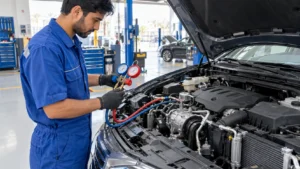
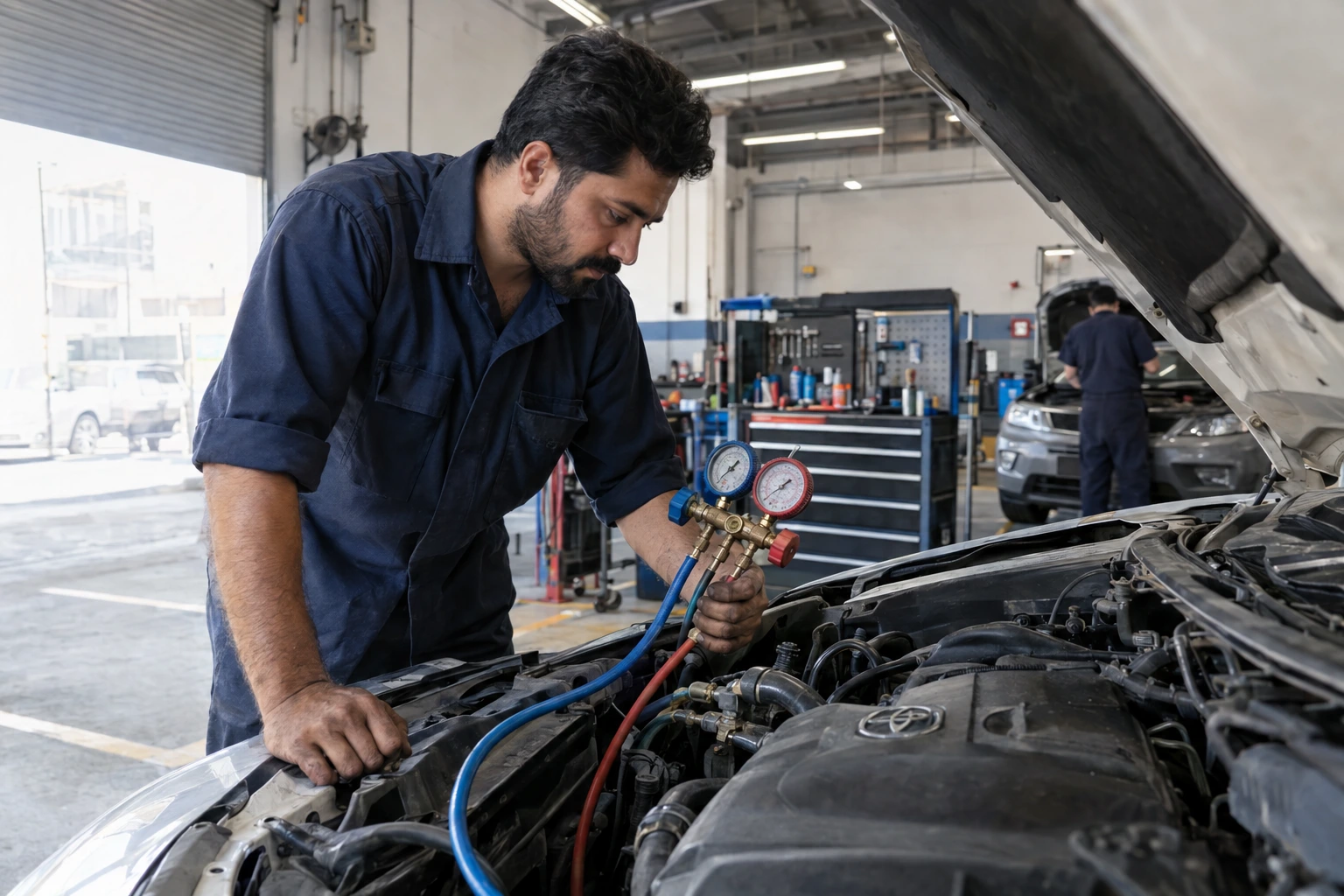
When your car AC stops cooling properly in Sharjah’s heat, the discomfort is immediate. But weak cooling is rarely just a matter of topping up the gas. The actual cause could be a refrigerant leak, a failing compressor, a blocked condenser, or an electrical fault—and each one needs a different fix. Jumping to a gas top-up before doing a proper car air conditioning repair diagnosis often wastes money and leaves the real problem untouched. In this guide, I’ll walk through every common symptom, what it likely means, and how proper car AC repair actually works—so you know exactly what to expect before you hand over your keys.
Why Is My Car AC Not Cooling? The Quick Answer
If your car AC is not blowing cold air, the most common reasons are:
- Low refrigerant due to a slow leak somewhere in the system
- A faulty or failing AC compressor that can no longer pressurize the refrigerant
- A blocked or damaged condenser reducing heat dissipation
- A clogged cabin air filter restricting airflow into the cabin
- An electrical fault such as a blown fuse, failed relay, or sensor problem
The short answer: car AC not cooling properly almost always points to one of these five areas. A proper AC diagnostic test identifies which one before any parts are replaced or gas is added.
Car AC Symptoms and What Each One Usually Means
Car AC Blowing Hot or Warm Air
This is the most common complaint. When the AC is blowing hot air, the system is usually either low on refrigerant due to a car AC leak or the compressor has stopped compressing the refrigerant properly. A refrigerant leak doesn’t always show up as a dramatic loss—sometimes the level drops slowly over months until cooling performance falls noticeably. A compressor fault is more sudden and is often accompanied by other signs.
AC Cold at First, Then Turns Warm
This pattern usually points to a freezing evaporator or a faulty expansion valve. The expansion valve controls how much refrigerant enters the evaporator. When it sticks or fails, the evaporator can ice up, briefly cool the air, and then block airflow completely once the ice builds up. The result is cold air for the first few minutes and warm air after that.
Weak Airflow from the Vents
If the air temperature is fine but the airflow feels weak, the issue is usually before the air even reaches the refrigerant system. A clogged cabin air filter is the first thing to check. If the filter is clean, a failing blower motor or a fault with the blower resistor is the likely cause. Weak airflow reduces the overall cooling performance of the system even when the refrigerant and compressor are working correctly.
Noises When the AC Is On
Squealing or Belt Noise
A high-pitched squeal when the AC is switched on often points to the drive belt. The compressor puts extra load on the belt when it engages. If the belt is worn or the tension is off, it may slip and squeal.
Rattling or Grinding
A rattling or grinding noise that starts when the AC compressor kicks in is more serious. It can indicate worn bearings inside the compressor or debris in the system. Continuing to run the AC in this condition can cause internal compressor damage that turns a repair into a full replacement.
Clicking On and Off
A rapid clicking or cycling sound—where the compressor clutch engages and disengages repeatedly—often means the refrigerant level is too low. The system has a pressure switch that cuts the compressor off when pressure drops below a safe threshold. If the compressor clutch keeps clicking, a proper leak check should come before any refrigerant recharge.
Bad Smell from the Vents
A musty smell usually means mold or bacteria have built up on the evaporator or inside the cabin filter housing. This is common in UAE conditions because the evaporator stays damp from condensation. A burning smell is different and warrants immediate attention—it can indicate an electrical fault or a slipping drive belt.
Water Inside the Cabin vs. Water Under the Car
Water dripping under the car near the passenger side is normal—it is condensation draining from the evaporator. Water appearing inside the cabin on the floor mat is not normal. It means the condensate drain line is blocked and water is backing up into the cabin instead of draining out.
AC Works Only While Driving
If the AC cools reasonably well at speed but struggles or stops cooling in traffic or at idle, the condenser cooling fan is the likely suspect. The condenser relies on airflow to release heat. At speed, moving air provides that flow. At idle, the fan must do the work. If the fan is weak or not running, the condenser overheats and the system loses cooling performance.
AC Not Working at All
When the AC does not switch on at all—no compressor engagement, no airflow—check the fuses and relays first. Electrical faults, including failed pressure sensors and wiring problems, can shut the system down completely without any mechanical failure.
Symptom Quick Reference Table
| Symptom | Likely Cause | What a Workshop Checks |
|---|---|---|
| Hot or warm air | Low refrigerant, compressor fault | AC pressure test, compressor function |
| Cold then warm | Frozen evaporator, expansion valve | Expansion valve, evaporator temperature |
| Weak airflow | Cabin air filter, blower motor | Filter condition, blower motor output |
| Squealing noise | Drive belt | Belt tension and condition |
| Rattling or grinding | Compressor bearings | Compressor internals |
| Rapid clicking | Low refrigerant pressure | System pressure, leak detection |
| Musty smell | Evaporator mold | Evaporator and filter |
| Water inside the cabin | Blocked drain line | Condensate drain |
| Works only while driving | Condenser fan | Fan operation and wiring |
| AC won’t turn on. | Fuse, relay, sensor | Electrical circuit and sensors |
Why Car AC Fails Faster in Sharjah’s Heat and Dust
High Ambient Temperature Puts Extra Load on the Compressor
In the UAE summer, ambient temperature regularly exceeds 45°C. The AC system has to work significantly harder to bring cabin temperature down from that baseline. The compressor runs longer and under higher pressure, which accelerates wear on components that might last years longer in a cooler climate.
Dust and Sand Block the Condenser and Cabin Filter
The condenser sits at the front of the car and relies on clean airflow to release heat. In Sharjah, fine dust and sand accumulate on the condenser fins and reduce its ability to cool the refrigerant. A partially blocked condenser raises system pressure and reduces cooling performance noticeably. The cabin air filter faces the same problem and can block up faster than the manufacturer’s recommended service interval suggests.
A Car Parked in the Sun Forces the AC to Work Harder
A car parked in direct sun in Sharjah can reach interior temperatures above 70°C. When the AC is switched on, it takes considerable time and system effort to bring that down. Using recirculation mode after the initial cool-down reduces the load on the system because it recirculates already-cooled air rather than drawing in hot outside air. Switching to outside air too early forces the system to work harder than necessary.
Why Summer Is the Worst Time to Find Out Your AC Is Weak
A system with a slow refrigerant leak or a marginal compressor may cope through winter. When summer arrives and the system load increases, the weakness becomes obvious. By that point, the compressor may have already suffered additional damage from running low on refrigerant, which carries the lubricating oil the compressor needs. Early spring AC inspection avoids this.
Car AC Gas Filling vs. Real Repair
What Car AC Gas Is, and Why It Shouldn’t Run Out
The refrigerant in a car’s HVAC system—typically R134a in older vehicles and R1234yf in newer ones—operates in a closed loop. Unlike engine oil, it is not consumed during normal operation. If the refrigerant level is low, gas has escaped through a leak somewhere in the system. The leak must be found and fixed. Simply refilling the refrigerant without addressing the leak means the same gas will escape again.
When a Gas Top-Up Is Enough
A car AC refrigerant recharge without leak repair is appropriate only when the system has been recently opened for a legitimate repair—for example, after compressor replacement—and needs to be recharged and vacuumed properly. If the system has not been opened and the refrigerant level is low, a leak exists.
Why Repeated Top-Ups Point to a Leak
If your AC was topped up last summer and needs topping up again this summer, the gas has gone somewhere. Car AC leak repair should have been part of the first visit.
Continuing to top up without fixing the leak is not a repair—it is a temporary symptom mask that costs money repeatedly and allows the underlying damage to continue. If you are unsure whether your system has a leak or simply needs recharging after a legitimate repair, our dedicated car air conditioning repair service page explains what a proper inspection covers and what to expect before any work begins
How Workshops Find Leaks
Proper car AC leak repair starts with an AC pressure test to confirm the system cannot hold pressure. After that, UV dye leak detection is commonly used—a fluorescent dye is introduced into the system, and a UV light reveals exactly where the leak is occurring. Some workshops also use electronic refrigerant sniffers for smaller leaks. The leak location determines the repair: it may be a hose, an O-ring, the condenser, the evaporator, or a fitting.
Why a Quick Gas Fill Without a Leak Check Is a Red Flag
If a workshop offers to top up your gas without testing pressure or looking for a leak, that is not a repair. It may cool the car for a few weeks, but it does not fix the problem. Before agreeing to a refrigerant recharge, ask whether the workshop will first perform a pressure test and leak check.
Before agreeing to a refrigerant recharge, ask whether the workshop will first perform a pressure test and leak check. Refrigerant handling in vehicles is governed by vehicle air conditioning safety standards that require proper recovery and recharge procedures—not simply venting old gas and refilling.
How Car AC Repair Works at a Workshop, Step by Step
Step 1: Contact and Describe the Problem
Before any work begins, describing the symptoms clearly saves time. When does the cooling fail — immediately, after a few minutes, or only in traffic? Are there any noises? Has the car been elsewhere for AC work recently?
Step 2: Inspection and AC Diagnostic
The workshop carries out a car AC inspection and AC diagnostic test, which includes checking the compressor operation, condenser condition, refrigerant pressure, electrical connections, blower motor function, and cabin filter condition.
Step 3: Pressure Test and Leak Detection
An AC pressure test confirms whether the system is holding charge. If pressure is low, leak detection identifies the source before any refrigerant is added.
Step 4: Clear Quote, Work Starts Only After Your Approval
A proper car AC repair shop will not begin work without showing you what needs fixing and what it will cost. This is the point to ask about part quality — genuine parts vs aftermarket — and to confirm the scope of work.
Step 5: Repair or Part Replacement
The confirmed fault is repaired. This may involve replacing a compressor, condenser, evaporator, expansion valve, hose, O-ring, blower motor, or other component — or a combination of these.
Step 6: Vacuum, Recharge and Cooling Test
After the repair, the system is evacuated with a vacuum pump to remove moisture and air, then recharged with the correct refrigerant to the manufacturer’s specification. The cooling performance is tested before the car is returned.
Step 7: Quality Check and Delivery
The car is checked again to confirm the fault has been resolved and that no new issues were introduced during the repair.
How Long Does Car AC Repair Take?
A straightforward refrigerant recharge with leak repair may be completed the same day. Compressor replacement or evaporator work takes longer because of the labour involved in accessing those components. The actual time depends on the fault and the vehicle.
Common Car AC Repairs: Repair or Replace?
Can a Car AC Compressor Be Repaired?
This is one of the most common questions. Whether a car AC compressor is repairable depends on what has failed inside it.
Compressor Clutch Problems vs Internal Failure
The compressor clutch is a separate component from the compressor body itself. If the clutch is slipping, not engaging, or making noise, it can often be replaced on its own — which is significantly less expensive than replacing the entire compressor. However, if the compressor has internal bearing failure, seized pistons, or has been run dry due to low refrigerant (which strips the lubricating oil from the system), the compressor body itself usually needs replacing. A proper car AC diagnostic test confirms which situation applies before any parts are ordered.
Condenser: Cleaning, Repair or Replacement
The condenser can sometimes be cleaned if the issue is blocked fins. If it has been physically damaged — bent fins from road debris, or a crack or pinhole leak — car AC condenser repair is rarely practical and replacement is the more reliable solution.
Evaporator Problems and When Replacement Is Likely
The evaporator sits deep inside the dashboard. When it develops a leak or is physically damaged, the labour cost of accessing it is significant regardless of part cost. Evaporator replacement is a major repair, which is why a UV dye leak test to confirm the leak location before committing to the work matters.
Expansion Valve and Receiver Drier
The expansion valve controls refrigerant flow into the evaporator. When it fails, it usually sticks either open or closed. It is not repairable — replacement is the standard fix. The receiver drier, which filters moisture from the refrigerant, is typically replaced whenever the system is opened, because moisture contamination causes ongoing problems.
Blower Motor and Resistor Faults
Weak or no airflow from the vents despite the system running is often a blower motor or blower resistor fault. The resistor controls fan speeds, so a failed resistor may mean only some speed settings work. Both components are replaceable without opening the refrigerant circuit.
Hoses, Seals and O-rings
Many refrigerant leaks originate at rubber hoses, fittings, or O-ring seals rather than at major components. These are generally straightforward to replace once the leak location is confirmed and are significantly less expensive than component replacement.
AC Electrical Faults, Sensors and Relays
Pressure sensors, temperature sensors, and relays all influence whether the AC system operates correctly. A failed pressure sensor may prevent the compressor from engaging even when everything else is in working order. These are diagnosed with an AC diagnostic test rather than by guesswork.
Cabin Air Filter Replacement
A blocked cabin air filter reduces airflow and puts extra load on the blower motor. It is the simplest and least expensive item in the AC system to service and is worth checking before assuming a more complex fault.
Repair or Replace Quick Reference
| Part | Common Sign | Usually Repair or Replace? |
|---|---|---|
| Compressor clutch | Clicking, not engaging | Replace clutch only if body is sound |
| Compressor body | Grinding, no cooling | Replace |
| Condenser | Blocked fins, visible leak | Clean if blocked; replace if leaking |
| Evaporator | Refrigerant leak, musty smell | Replace |
| Expansion valve | Cold then warm pattern | Replace |
| Receiver drier | Moisture in system | Replace when system is opened |
| Blower motor | No or weak airflow | Replace |
| Blower resistor | Only some fan speeds work | Replace |
| Hoses and O-rings | Refrigerant leak at joints | Replace seals and fittings |
| Cabin air filter | Weak airflow, smell | Replace |
How Much Does Car AC Repair Cost in Sharjah?
What Affects the Price
Type of Fault
A cabin filter replacement costs a fraction of what an evaporator replacement costs. The fault type is the biggest single factor in the final price.
Part Quality: Genuine Parts vs Aftermarket
Genuine parts from the vehicle manufacturer cost more than aftermarket alternatives but are manufactured to the vehicle’s original specification. Aftermarket parts vary widely in quality. For major components like the compressor, genuine parts or quality OEM-equivalent parts are worth the additional cost. Ask the workshop which they are supplying and why.
Labour Time and Car Make
Some vehicles make AC components far more accessible than others. A compressor that takes two hours to reach on one model may take five hours on another because of how the engine bay is packaged. Japanese vehicles — Toyota, Nissan — are generally more straightforward to work on than some European models. Labour time directly affects the total car AC repair cost.
Why the Cheapest Quote Can Cost More Later
A very low car AC repair price is sometimes achieved by skipping the pressure test, skipping leak detection, using the lowest-quality parts, or adding gas without fixing the underlying fault. When the problem returns — and it will — the second repair costs more than the proper first repair would have.
How to Get a Fixed Quote Before Work Starts
Ask the workshop to carry out the inspection and diagnostic first, then provide a written quote before any repair begins. A workshop that begins work without your approval or cannot give a clear breakdown of parts and labour is one to be cautious about.
Do Different Car Makes Have Different AC Problems?
Toyota and Nissan AC Repair
Toyota and Nissan are among the most common vehicles in Sharjah. Their AC systems are generally reliable, but compressor clutch wear and condenser leaks appear with age and high mileage. Refrigerant leaks at O-rings and fittings are common on older examples. Parts availability is generally good.
Hyundai and Kia AC Repair
Hyundai and Kia vehicles sometimes develop expansion valve problems and evaporator leaks at higher mileages. Blower motor faults also appear. Parts are generally available, though some older models may require ordering.
German and Luxury Cars
BMW, Mercedes-Benz, and Audi AC systems are more complex and more sensitive to refrigerant level and part quality. Some use R1234yf refrigerant, which requires specific equipment to handle. Diagnostic work on these vehicles requires equipment that can communicate with the manufacturer’s electronic systems rather than a generic scanner.
Does the Workshop Repair All Makes and Models?
Jawharat Al Sahil Auto Maintenance handles a range of vehicle makes and models across Japanese, Korean, and European cars. If you are unsure whether your vehicle is covered, or if your car needs additional work beyond the AC system, you can see the full list of car repair services in Sharjah available at the workshop before booking.
How to Choose a Car AC Repair Center in Sharjah
8 Questions to Ask Before You Book
- Do you carry out a pressure test and leak check before topping up the gas?
- Will you give me a written quote before starting work?
- What parts will you use — genuine or aftermarket?
- Do you have the equipment to handle my vehicle’s refrigerant type?
- How long will the repair take?
- What happens if the same fault returns after the repair?
- Do you carry out a cooling test after the repair is complete?
- Can I speak to the technician about what was found?
Red Flags to Avoid
- A workshop that offers a gas top-up without any diagnostic or pressure test
- No written quote before work begins
- No explanation of what was found or what was replaced
- Very low prices that don’t account for diagnosis
- No cooling test after the repair
Independent Workshop vs Dealer vs Mobile AC Repair
Dealerships use genuine parts and manufacturer-trained technicians, but the labour rates are high and booking times can be long. Independent workshops that specialize in car aircon repair can offer the same quality of work at more accessible prices, provided they have the right diagnostic equipment and genuine or quality parts. Mobile repair is suitable for straightforward jobs such as cabin filter replacement, but most AC repairs — leak detection, vacuum, recharge, compressor work — require workshop equipment.
Car AC Repair Near Me: What to Check on Google Maps
When searching for car AC repair near me, look at the number of reviews and the consistency of feedback rather than just the star rating. Check whether the photos show an actual workshop with equipment. Look at the opening hours and whether the business responds to reviews. A workshop with 200 genuine reviews and consistent feedback tells you more than a star rating alone.
Car AC Repair in Sharjah Industrial Area: What to Expect
The Industrial Area in Sharjah has a concentration of specialist auto workshops with the equipment and parts availability that a car AC repair shop in a residential area may not have. Jawharat Al Sahil Auto Maintenance is located in Al Qassim, Industrial Area 4, Sharjah, and carries out car AC repair service alongside broader automotive maintenance work.
Pickup and Drop-Off Service in Sharjah
If getting the car to the workshop is a problem, Jawharat Al Sahil Auto Maintenance offers a vehicle pickup service. You can submit a request through the website. Once the inspection is complete and the fault is diagnosed, the workshop will provide a quote before any work begins. The car is returned after the quality check.
Most AC repairs — compressor work, refrigerant leak repair, evaporator replacement — require workshop equipment and cannot be performed at the roadside or at home. Pickup is a practical option when the car is difficult or uncomfortable to drive in Sharjah heat with a failed AC.
Safe Checks You Can Do Before Visiting a Workshop
Check the Cabin Air Filter and Airflow
The cabin air filter is usually accessible behind the glove box without tools. If it is visibly dirty or blocked, replacing it is inexpensive and may restore airflow. If the airflow improves but the air is still not cold, the problem is elsewhere.
Check That the Engine Cooling Fan Runs When the AC Is On
With the engine running and the AC switched on, look at the cooling fan at the front of the engine bay. It should be running. If it is not, the condenser cannot release heat properly at idle, and the AC will struggle in traffic.
Check for Visible Oil Stains Near AC Lines
Refrigerant carries compressor oil. A refrigerant leak often leaves an oily residue on hose fittings, the compressor body, or the condenser. Visible oil staining near these components suggests a leak location that a workshop can confirm with a proper pressure test.
Why DIY Gas-Can Refills Can Cause Damage
DIY refrigerant cans sold at accessory shops may temporarily add gas, but they cannot perform a pressure test, find the leak, or add the correct amount. Overcharging the refrigerant can damage the compressor. Adding refrigerant to a system with a serious leak simply delays the proper repair. If a leak exists, the gas will be gone again within weeks.
Car AC Maintenance Tips for Sharjah Drivers
Run the AC Regularly, Even in Cooler Months
Running the car AC for at least ten minutes each week — even during winter — keeps the compressor seals lubricated and prevents them from drying out and cracking. A system that sits unused for months is more likely to develop seal leaks.
Use Recirculation Mode Correctly
Recirculation mode draws air from inside the cabin and recools it rather than pulling in hot outside air. It cools the cabin faster and reduces the load on the system. However, running recirculation for extended periods without bringing in any fresh air can cause the windows to fog in humid conditions. Use it to cool the cabin quickly, then switch to outside air once a comfortable temperature is reached.
Ventilate a Hot Car Before Switching the AC On
Opening the windows for thirty seconds to a minute before switching on the AC allows the hottest air to escape first. Starting the AC in a 70°C cabin immediately puts the system under maximum load from the first second.
Replace the Cabin Filter on Schedule
In Sharjah conditions, the cabin filter may need replacing more frequently than the manufacturer’s standard interval because of dust. Checking it annually or every 15,000 km is a reasonable starting point.
Keep the Condenser Clean
If the front of the car shows a buildup of dust and debris on the condenser fins, a careful rinse with low-pressure water (not a high-pressure jet directly at the fins) can restore airflow. A workshop can clean it properly during a car AC service visit.
How Often to Service the AC
A car AC inspection is worth including in the annual service schedule, particularly in Sharjah. Checking refrigerant pressure, drive belt condition, condenser condition, and cabin filter takes a short time and can identify a developing problem before it becomes a breakdown in summer.
Don’t Ignore Small Warning Signs
A slight reduction in cooling performance in spring, an occasional smell, or an intermittent noise are easier and cheaper to fix before summer than after the system has been running under maximum load for three months.
An annual car AC inspection is a sensible baseline for vehicles driven in Sharjah. Given the heat, dust, and extended AC usage, the system works harder than in most other climates and benefits from regular checks of refrigerant pressure, drive belt condition, and filter condition. Combining an AC check with your routine auto car maintenance in Sharjah visit is a practical way to keep both the AC system and the vehicle in good condition without a separate trip to the workshop.
Car AC Repair FAQs
Why is my car AC blowing warm air?
The most common causes are low refrigerant from a leak, a failing compressor that can no longer pressurize the refrigerant, or a blocked condenser. An AC pressure test identifies which of these is responsible. A gas top-up without a leak check will not fix the underlying problem and the cooling loss will return.
Is a gas top-up enough, or do I need a repair?
If the refrigerant level is low, gas has escaped through a leak. A top-up without finding and fixing the leak is temporary. The correct approach is to test the system pressure, find the leak with UV dye or an electronic sniffer, repair the source, then recharge. In most cases, a top-up alone is not enough.
Can a car AC compressor be repaired?
It depends on what has failed. If the compressor clutch has failed but the compressor body is sound, the clutch can be replaced separately at a lower cost. If the compressor internals are damaged — which often happens when it has been run with low refrigerant — the compressor itself usually needs replacing. A proper AC diagnostic confirms which situation applies.
How much does car AC repair cost in Sharjah?
The cost depends on the fault, the vehicle make, and the parts required. A cabin filter replacement costs very little. A compressor replacement on a luxury vehicle costs significantly more. Getting a written quote after the diagnostic inspection — before any work begins — is the best way to understand the actual cost for your specific vehicle and fault.
How long does car AC repair take?
Simple jobs like a refrigerant recharge or cabin filter replacement may be completed the same day. Compressor replacement, evaporator work, or a repair that requires opening the refrigerant circuit takes longer because of the vacuum and recharge process. The actual time depends on the fault and the vehicle.
Book Your Car AC Check in Sharjah
If your car AC is not cooling properly, a diagnostic inspection is the right first step — before any gas is added or parts are replaced.
Jawharat Al Sahil Auto Maintenance is located in Al Qassim, Industrial Area 4, Sharjah. The workshop carries out car AC inspection, leak detection, compressor repair, refrigerant recharge, and general car AC service for a range of vehicle makes and models.
You can contact the workshop by phone or WhatsApp, or submit a pickup request through the website at jawharatalsahilautomaintenance.com.
Bring the car in before the summer peak if you have noticed any early signs — reduced cooling, occasional smells, or a compressor noise — and the fault is more likely to be a straightforward fix rather than a breakdown repair.