Auto Car Maintenance Services We Offer in Sharjah
Most workshops in Sharjah handle either mechanical work or body repair. Not both under one roof.
I run a full-service garage, and that means when you bring your car in, I can fix the engine problem and straighten the dented door at the same time. You don’t need to visit two places or explain the same issue twice.
Here’s what I handle on-site.
Engine & Mechanical Repair in Sharjah
Engine trouble usually shows up as rough idling, loss of power, or that check engine light that won’t go away.
Engine problems can cause rough idling, loss of power, unusual noises, or a persistent check engine light. A proper inspection may include computerized diagnostics along with a physical check of the engine and related components. Depending on the symptoms, the issue could involve sensors, the timing system, lubrication, cooling system, or internal engine components.
Oil breaks down faster here. The 10,000 km service interval that works in Europe doesn’t work in 45-degree heat. I’ve pulled oil at 5,000 km that looked like tar.
If your engine needs internal work, I handle valve jobs, gasket replacements, and full rebuilds. I also fix oil leaks, coolant leaks, and overheating caused by a failing water pump or clogged radiator. Every repair gets a test drive before I hand the keys back.
Car AC Repair & Gas Refill in Sharjah
A weak AC in Sharjah isn’t just annoying. It’s dangerous.
When your AC blows warm air, the cause is usually low refrigerant, a failing compressor, or a clogged condenser. I check the system pressure first, then inspect for leaks using UV dye. If the compressor clutch isn’t engaging, that’s often an electrical fault or a blown fuse.
AC gas refill is the most common request I get. But refilling gas without fixing the leak is a waste of money. The gas will disappear again in two weeks.
I find the leak, fix it, vacuum the system to remove moisture, then refill with the correct refrigerant type (R-134a or R-1234yf depending on your car model). Using environmentally approved refrigerants is mandatory under UAE environmental regulations.
I also replace cabin air filters during AC service because a clogged filter cuts airflow by half. Most cars in Sharjah need a new cabin filter every six months, not once a year.
Compressor replacement is the bigger job. If your compressor has seized, I replace it along with the receiver dryer and expansion valve to prevent contamination in the new unit.
Auto Electrical & Diagnostic Services in Sharjah
Electrical problems are the hardest to diagnose without the right tools.
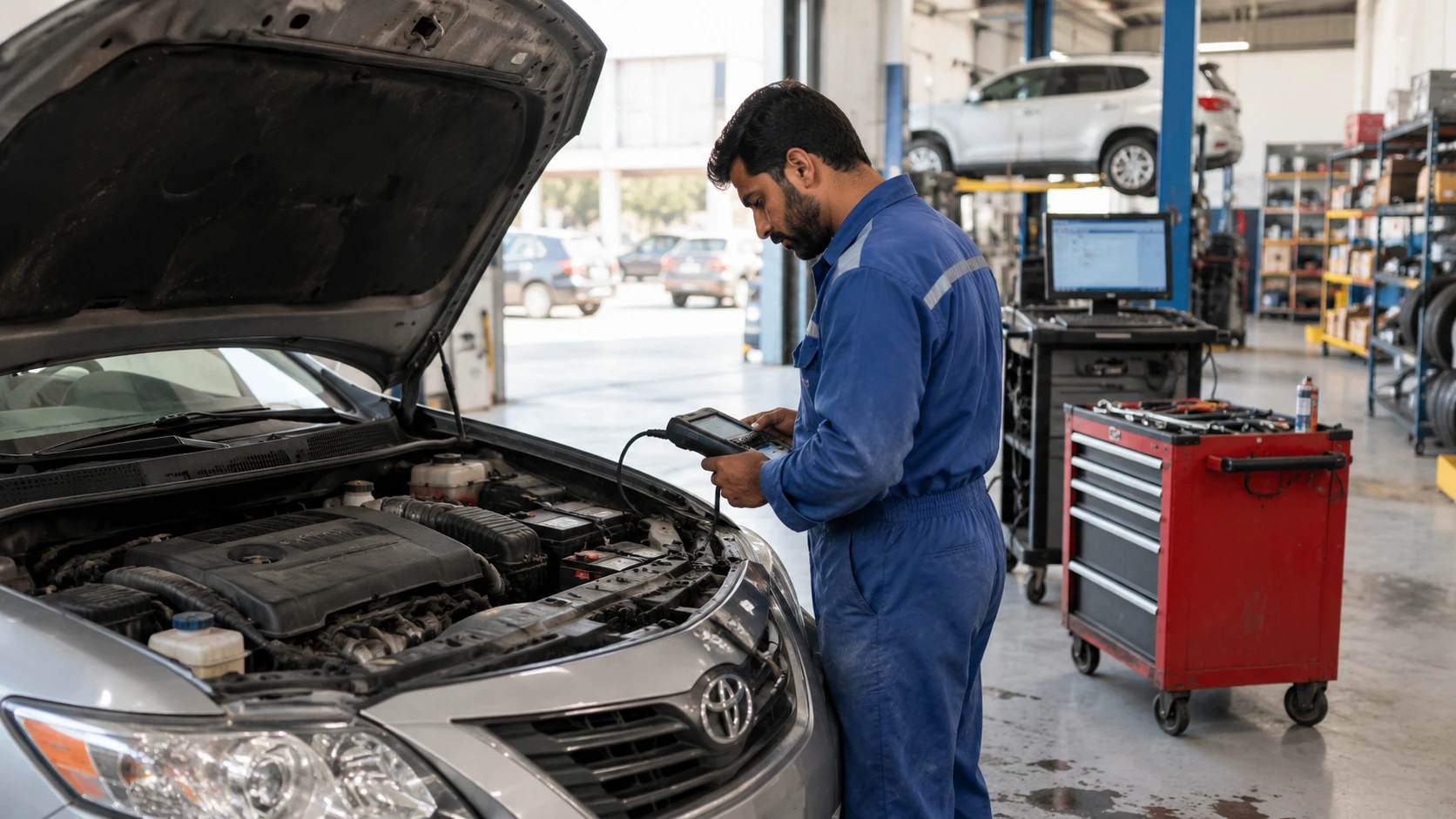
I use a full diagnostic scanner that reads every control module in your car. That includes the engine ECU, ABS module, airbag system, and transmission controller. When a warning light appears on your dashboard, the scanner pulls the exact fault code and tells me which component failed.
Common electrical issues I fix alternator failure, starter motor problems, battery drain, and blown fuses. If your car won’t start and the battery is fine, it’s usually the starter or a bad connection at the battery terminal.
Alternator problems show up as flickering dashboard lights or a battery warning light. I test alternator output with a multimeter. If it’s putting out less than 13.5 volts while the engine is running, it needs replacement.
I also handle wiring repairs for headlights, taillights, power windows, and central locking. Rodent damage to wiring harnesses is more common than people think, especially if the car sits unused for weeks.
Oil Change & Brake Pad Replacement in Sharjah
Oil change intervals in Sharjah should be shorter than the manufacturer recommends.
I change engine oil every 5,000 to 7,000 km for most cars, not 10,000. The heat here oxidizes oil faster, and that means it stops protecting your engine earlier. I use fully synthetic oil for every car because mineral oil breaks down too quickly in this climate.
During an oil change, I also inspect the oil filter, air filter, coolant level, brake fluid, and all belts. If your serpentine belt has cracks, it will snap without warning and leave you stranded.
Brake pads wear faster here because of stop-and-go traffic and the extra weight from running the AC constantly. When I hear a grinding noise during braking, the pads are already metal-on-metal and the rotors are damaged.
I replace brake pads before they reach that point. I also measure rotor thickness and check brake fluid for moisture contamination. Old brake fluid absorbs water and lowers the boiling point, which causes brake fade on long downhill runs or in heavy traffic.
Suspension & Steering Repair in Sharjah
Potholes and speed bumps destroy suspension components faster than normal driving.
When your car pulls to one side, makes clunking noises over bumps, or feels unstable at highway speed, the suspension needs attention. I inspect shock absorbers, control arms, ball joints, tie rod ends, and stabilizer links.
Shock absorbers wear out gradually, so most drivers don’t notice until the car starts bouncing after every bump. I do a bounce test on all four corners. If the car bounces more than once after I push down on the fender, the shocks are done.
Wheel alignment is part of every suspension repair. Misaligned wheels cause uneven tire wear and make the car pull left or right. I align all four wheels using a computerized alignment machine, not guesswork.
Steering problems usually come from a worn tie rod end or a failing power steering pump. If the steering feels heavy or you hear whining when you turn the wheel, the power steering fluid is low or the pump is failing.
Accident Repair & Car Denting in Sharjah
I handle accident damage from minor door dings to full front-end collision repair.
Panel beating is the process of straightening metal panels back to their original shape without replacing them. I use hammers, dollies, and a stud welder to pull out dents and restore body lines. This saves money compared to replacing entire panels.
For deeper dents or creased metal, I remove the panel, work it from the inside, and reshape it on a workbench. If the damage is too severe, I source and fit a replacement panel, then blend the paint so the repair is invisible.
I also fix frame damage using a hydraulic frame straightening machine. If your car was hit hard enough to bend the chassis, it won’t drive straight until the frame is pulled back into alignment.
Insurance claims are handled directly. I provide a detailed estimate, photograph the damage, and work with your insurance adjuster to approve the repair scope.
Car Painting & Color Matching in Sharjah
Paint work is where most cheap body shops fail.
I mix paint using your car’s factory paint code, then spray a test panel to confirm the match before I touch your car. Color matching isn’t just about the code. It’s about adjusting for factory variations and paint fade from sun exposure.
Before painting, I sand the surface smooth, apply primer, block sand the primer, then apply a sealer coat. Only then does the base coat go on. Most workshops skip the sealer, and that’s why the paint peels a year later.
I apply three coats of base color and two coats of clear lacquer. Each coat is allowed to flash off before the next one goes on. The final clear coat is wet sanded and polished to a factory-level gloss.
Full resprays take longer because I remove trim pieces, mask glass and rubber seals, and paint inside the door jambs and under the hood. A proper full respray takes three to five days, not one.
Body Kits & Car Modifications in Sharjah
Body kit installation is more than bolting plastic onto your bumper.
I fit front lips, side skirts, rear diffusers, and full wide-body kits. Every kit requires test fitting, trimming, alignment, and secure mounting using a combination of bolts, rivets, and automotive adhesive. Cheap installs use double-sided tape. That fails in Sharjah heat within a month.
I also customize bumpers, hoods, and fenders. If you want a custom look, I work with fiberglass and carbon fiber to create one-off pieces or modify existing parts.
Modifications need to respect RTA regulations. I don’t install anything that will fail a vehicle inspection or create a safety issue. Lowering springs, aftermarket exhaust systems, and body kits are fine as long as they meet legal limits.
Paint matching for body kits is included in every install. A black plastic lip on a metallic silver car looks cheap. I paint every add-on part to match your car’s factory color before installation.
Car Repair Services Based on Your Vehicle’s Symptoms
Most people don’t know what’s wrong with their car. They just know something feels off.
That’s normal. You don’t need to diagnose the problem yourself. But knowing what each symptom usually points to helps you understand what I’m checking and why the repair costs what it does.
Here’s how I match common symptoms to actual causes.
Car Diagnostics & Warning Light Inspection in Sharjah
A dashboard warning light can indicate that the vehicle has detected a problem or that a system needs attention
The check engine light can appear for many reasons, ranging from relatively minor issues to problems that require immediate attention. It can mean anything from a loose gas cap to a failing catalytic converter. I plug in a diagnostic scanner and pull the fault code. That code tells me which sensor triggered the light or which system is malfunctioning.
“The battery warning light can indicate a problem with the charging system, such as the alternator, battery, wiring, or related components. If this light comes on while you’re driving, you have maybe 20 minutes before the battery dies and the engine shuts off. Don’t ignore it.
ABS or brake warning lights usually mean low brake fluid or a faulty ABS sensor. Sometimes it’s just a worn brake pad sensor doing its job. I check fluid level first, then scan the ABS module for fault codes.
The oil pressure warning light is the one you never ignore. If this light stays on after startup, stop the engine immediately. Driving with low oil pressure destroys the engine in minutes. I check oil level and then oil pressure with a mechanical gauge to confirm whether it’s a real pressure problem or just a bad sensor.
An airbag light means the system has deactivated itself. It won’t deploy in a crash until the fault is fixed. Common causes are a loose connector under the seat or a faulty clock spring in the steering wheel.
What Each Symptom Usually Means
Check engine light:
- Loose or faulty gas cap
- Oxygen sensor failure
- Catalytic converter efficiency below threshold
- Mass airflow sensor malfunction
- Ignition coil or spark plug misfire
Battery warning light:
- Alternator not charging
- Worn alternator belt
- Bad battery connection
- Faulty voltage regulator
ABS or brake warning light:
- Low brake fluid level
- Worn brake pads (sensor triggered)
- ABS wheel speed sensor fault
- ABS pump or module failure
Oil pressure warning light:
- Low engine oil level
- Oil pump failure
- Blocked oil filter
- Worn engine bearings
- Faulty oil pressure sensor
Airbag warning light:
- Loose connector under driver or passenger seat
- Faulty clock spring in steering column
- Previous accident damage to airbag sensors
- Faulty airbag control module
Car Starting & Electrical Repair in Sharjah
When you turn the key and nothing happens, most people assume it’s the battery.
Sometimes it is. But not always.
I start by checking battery voltage. A healthy battery reads 12.6 volts or higher when the engine is off. Anything below 12.4 volts means the battery is partially discharged. Below 12 volts and it won’t have enough power to crank the engine.
If the battery is fine, I check the starter motor. When you turn the key, you should hear a click from the starter solenoid. No click means the solenoid isn’t getting power, which points to a faulty ignition switch, neutral safety switch, or a wiring issue.
One click but no cranking means the starter motor itself has failed. I remove it, bench test it, and replace it if the motor or solenoid is burned out.
If the engine cranks but won’t fire up, the problem is fuel, spark, or air. I check for spark at the plugs, confirm fuel pressure at the rail, and make sure the air filter isn’t completely clogged. A failed fuel pump is common on higher-mileage cars, especially if the tank is regularly run near empty.
What Each Symptom Usually Means
No crank, no click:
- Dead battery
- Corroded or loose battery terminals
- Faulty ignition switch
- Blown main fuse
- Bad neutral safety switch (automatic transmission)
Click but no crank:
- Starter motor failure
- Weak battery with just enough power for the solenoid
- Bad starter solenoid
- Poor ground connection to engine block
Cranks but won’t start:
- Empty fuel tank (more common than you’d think)
- Failed fuel pump
- Clogged fuel filter
- No spark from ignition coils
- Faulty crankshaft position sensor
- Blown engine fuse or relay
Starts and then dies immediately:
- Immobilizer or anti-theft system active
- Faulty crankshaft or camshaft sensor
- Massive vacuum leak
- Fuel pressure regulator failure
Engine Overheating Repair in Sharjah
Engine overheating in Sharjah happens fast, and it can destroy an engine in under ten minutes if you keep driving.
The temperature gauge should remain within the normal operating range specified for your vehicle.Let it cool for at least 30 minutes before you even open the hood.
Most overheating is caused by low coolant. I check the coolant reservoir first. If it’s empty, there’s a leak somewhere. Common leak points are the radiator, water pump, heater hoses, or the thermostat housing.
A failing water pump won’t circulate coolant properly. You’ll see steam from under the hood, but the top radiator hose will feel cool instead of hot. That means coolant isn’t flowing.
Clogged radiator fins reduce airflow. If you drive through a sandstorm or park near construction sites, dust and debris pack into the radiator and block cooling. I pressure wash radiators from the engine side, not the front, to push debris out the way it came in.
The radiator fan should kick on when the engine reaches operating temperature. If it doesn’t, the fan motor, relay, or temperature sensor has failed. In traffic with no airflow, the fan is the only thing keeping the engine cool.
A blown head gasket lets combustion gases into the cooling system. You’ll see bubbles in the coolant reservoir and white smoke from the exhaust. This is the worst-case scenario and requires engine disassembly to fix.
What Each Symptom Usually Means
Temperature gauge in red zone:
- Low coolant level due to leak
- Faulty thermostat stuck closed
- Failed water pump
- Clogged radiator
- Radiator fan not working
- Blown head gasket
Steam from the hood:
- Coolant leak from hose or radiator
- Radiator cap failure (pressure not holding)
- Cracked coolant reservoir
White smoke from exhaust:
- Blown head gasket
- Cracked cylinder head
- Warped engine block (rare, from severe overheating)
Coolant loss with no visible leak:
- Internal head gasket leak (combustion gases pressurizing cooling system)
- Leak into engine oil (check for milky residue on oil cap)
Weak or No Air Conditioning
In Sharjah, a car with no AC is unusable for half the year.
When the AC blows warm air, I check refrigerant pressure first. Low pressure means the system has leaked gas. High pressure on both sides means the condenser is blocked or the radiator fan isn’t running.
AC compressor failure is the most expensive repair. If the compressor clutch doesn’t engage when you turn on the AC, the problem is either electrical (blown fuse, bad relay, faulty pressure switch) or mechanical (seized compressor).
A clogged cabin air filter cuts airflow by more than half. I’ve pulled cabin filters that were solid black with dust. Replacing that filter alone can make the AC feel twice as cold.
Condenser damage happens in minor front-end accidents. Even a small impact can bend the condenser fins or crack the tubes. A damaged condenser can’t reject heat, so the AC never gets cold.
A blended door actuator failure means the AC is cold, but the air coming out is warm because the heating door is stuck in the wrong position. This is common in cars with automatic climate control. I can hear the actuator clicking and struggling when you adjust the temperature.
What Each Symptom Usually Means
AC blows warm air:
- Low refrigerant due to leak
- Failed AC compressor
- Blocked or damaged condenser
- Faulty expansion valve or orifice tube
- Bad AC pressure switch
AC is cold, but airflow is weak:
- Clogged cabin air filter
- Failed blower motor
- Blower motor resistor failure (only some speeds work)
AC works for a few minutes, then stops:
- Refrigerant level too low (compressor cycles off to protect itself)
- Icing at the evaporator due to expansion valve fault
- Faulty AC pressure sensor
AC is cold, but air comes out warm:
- Blend door actuator stuck in heat position
- Heater control valve stuck open (coolant flowing through heater core)
Engine & Mechanical Repair for Noise, Vibration and Power Loss
Noises tell you exactly what’s failing if you know what to listen for.
A squealing sound when you start the engine means a worn or loose belt. It gets worse when you turn on the AC because that adds load to the belt. I check belt tension and condition. Cracks on the inner ribs mean it’s due for replacement.
Grinding noise when braking means the pads are completely worn and the metal backing plate is cutting into the rotor. This destroys the rotor and makes the repair twice as expensive. Replace pads when you hear squeaking, not grinding.
Knocking or rattling from the engine at idle can be a heat shield that’s come loose or something much worse, like a worn timing chain or failing engine mount. I locate the noise first before quoting a repair.
Vibration at idle that smooths out when you rev the engine usually points to a bad engine mount. Vibration at highway speed is almost always a wheel balance issue or a bent rim.
Power loss without warning lights can be a clogged fuel filter, weak fuel pump, or a boost leak if the car is turbocharged. I test fuel pressure and check for intake leaks using a smoke machine.
What Each Symptom Usually Means
Squealing or chirping sound from the engine bay:
- Worn serpentine belt
- Loose belt tensioner
- Failing alternator or AC compressor bearing
Grinding when braking:
- Brake pads completely worn (metal-on-metal contact)
- Seized brake caliper
- Warped brake rotor
Knocking or ticking from the engine:
- Low engine oil level
- Worn timing chain or tensioner
- Faulty hydraulic valve lifters
- Loose heat shield
Clunking over bumps:
- Worn suspension bushings
- Failed shock absorber or strut mount
- Loose or broken stabilizer link
- Bad control arm ball joint
Vibration at idle:
- Failed engine mount or transmission mount
- Misfiring cylinder
Vibration at speed:
- Unbalanced wheels
- Bent wheel rim
- Worn CV joint (front-wheel drive)
Loss of power or hesitation:
- Clogged fuel filter
- Weak fuel pump
- Dirty throttle body
- Boost leak (turbocharged cars)
- Faulty mass airflow sensor
Brake, Suspension & Steering Repair in Sharjah
When steering or braking changes, don’t wait to get it checked.
Steering that pulls to one side means alignment is out or you have uneven tire pressure. I check tire pressure first because that’s a 30-second fix. If pressure is even and it still pulls, the alignment needs adjustment.
Heavy steering usually means low power steering fluid or a failing power steering pump. The pump makes a whining noise when it’s dying, especially during slow-speed turns like parking.
Vibration in the steering wheel at highway speed points to unbalanced wheels or a bent rim. If it only happens during braking, the front rotors are warped.
Brakes that feel spongy or sink to the floor mean air in the brake lines or a leak in the hydraulic system. This is dangerous. I pressure test the system and bleed the brakes to remove air.
A pulsating brake pedal during normal braking means warped rotors. Hard stops from high speed or riding the brakes downhill overheats the rotors and warps them. I measure rotor thickness and runout with a dial gauge. If they’re warped beyond spec, they get replaced, not resurfaced.
What Each Symptom Usually Means
Steering pulls to one side:
- Wheel alignment out of spec
- Uneven tire pressure
- Worn or damaged suspension components
- Seized brake caliper (pulls during braking)
Heavy or stiff steering:
- Low power steering fluid
- Failing power steering pump
- Worn steering rack
- Incorrect tire pressure (overinflated)
The steering wheel shakes at speed:
- Unbalanced wheels
- Bent wheel rim
- Worn tie rod ends
- Loose wheel bearing
The steering wheel shakes when braking:
- Warped front brake rotors
- Uneven brake pad wear
Spongy or soft brake pedal:
- Air in brake lines
- Brake fluid leak (master cylinder, caliper, brake line)
- Worn brake pads (pedal travels farther)
Pulsating brake pedal:
- Warped brake rotors
- Uneven rotor surface
- Loose wheel bearing (feels similar)
The brake pedal goes to the floor:
- Major brake fluid leak
- Failed master cylinder
- Rear drum brake adjuster failure
Car Maintenance Services for Sharjah’s Heat and Dust
Cars in Sharjah work harder than cars anywhere else in the world.
The combination of 45-degree heat, dust storms, and stop-and-go traffic puts stress on every system in your car.
Sharjah’s high temperatures, dust, traffic conditions, and frequent use of air conditioning can place additional demands on a vehicle. Regular inspections of fluids, filters, cooling components, tires, and the AC system can help identify wear before it develops into a larger problem.
I’ve worked on cars in Sharjah for years, and the pattern is always the same. People follow the service schedule in their owner’s manual, then wonder why their engine overheated or their AC died. That manual was written for moderate climates. It doesn’t account for what happens when your engine bay hits 80 degrees just sitting in traffic.
Here’s what actually happens to your car in this climate and what you need to do differently.
Routine Car Maintenance Services in Sharjah
Your vehicle’s maintenance schedule should be based on the manufacturer’s recommendations, while driving conditions such as extreme heat, heavy traffic, dust, and frequent short trips may require additional inspections or more frequent maintenance for some components.
Most manufacturers recommend oil changes every 10,000 to 15,000 km. That works in Germany or the UK. Not here. Engine oil breaks down faster in extreme heat because thermal stress accelerates oxidation. I’ve tested oil at 7,000 km in Sharjah that looked like sludge.
I change engine oil every 5,000 to 6,000 km for most cars. If you do a lot of short trips under 10 km, make it every 5,000. Short trips never let the engine reach full operating temperature, and that means fuel and moisture contaminate the oil without getting burned off.
Coolant should be flushed every two years or 40,000 km, whichever comes first. Old coolant loses its ability to transfer heat and protect against corrosion. I’ve seen radiators rot from the inside because the coolant hadn’t been changed in five years.
Brake fluid absorbs moisture over time. In humid coastal areas like Sharjah, that happens even faster. I replace brake fluid every two years. Moisture in brake fluid lowers the boiling point, and that causes brake fade when you’re stuck in slow traffic with your foot on the pedal.
Transmission fluid doesn’t last forever, even if the manual says “lifetime fill.” Heat kills transmission fluid. I drain and refill automatic transmission fluid every 60,000 km. It’s cheaper than replacing a transmission at 120,000 km.
Battery life in Sharjah is three years on average, sometimes less. The heat accelerates the chemical reaction inside the battery and evaporates the electrolyte. I test battery health at every service. If it’s weak, I replace it before it leaves you stranded.
Tire pressure changes with temperature. I check and adjust tire pressure every month, not every six months. Underinflated tires generate more heat and wear on the outer edges. Overinflated tires wear in the center and give you a harsh ride.
Routine car maintenance in Sharjah should follow this schedule:
- Engine oil and filter: every 5,000 to 6,000 km
- Engine air filter: every 10,000 to 15,000 km (inspect every service)
- Cabin air filter: every 10,000 to 15,000 km
- Coolant flush: every 2 years or 40,000 km
- Brake fluid: every 2 years
- Transmission fluid: every 60,000 km
- Spark plugs: every 40,000 to 60,000 km (depends on plug type)
- Battery: test annually, replace every 3 years, or when weak
- Tire rotation: every 10,000 km
- Wheel alignment: every 20,000 km or after hitting a pothole
This schedule keeps your car reliable. Following the manufacturer’s “normal conditions” schedule in Sharjah guarantees expensive failures.
Engine & Cabin Air Filter Replacement
Air filters in Sharjah last half as long as they would in Europe.
The engine air filter stops dust and sand from entering the engine. When it clogs, airflow drops and the engine starts running rich because the air-fuel mixture is off. You’ll feel power loss and see worse fuel economy before the check engine light even comes on.
I inspect the engine air filter at every oil change. In dusty areas or during sandstorm season, I’ve replaced filters at 8,000 km that were completely black. The filter element should be white or light gray when new. If it’s dark brown or you can’t see light through it, it’s done.
A clogged engine air filter also lets fine dust past the seal and into the intake. That dust acts like sandpaper on cylinder walls and piston rings. I’ve seen engines with scoring on the cylinder walls because someone ran a collapsed air filter for 30,000 km.
The cabin air filter stops dust from entering the passenger compartment through the AC vents. When it clogs, airflow from the AC drops by half. You’ll notice weaker air from the vents even though the blower is on full speed.
I pull cabin air filters that are solid black with dust and packed with leaves and debris. Some are so clogged they’ve deformed from the suction pressure of the blower motor trying to pull air through them.
A clogged cabin air filter also makes the AC evaporator work harder because restricted airflow reduces heat exchange efficiency. That puts extra load on the compressor and shortens its life. Replacing a cabin filter costs 50 dirhams. Replacing a compressor costs 2,000.
I recommend inspecting both filters every 5,000 km and replacing them every 10,000 to 15,000 km depending on driving conditions. If you drive on unpaved roads, through construction zones, or during sandstorms, replace them more often.
Signs your engine air filter needs replacement:
- Loss of power or sluggish acceleration
- Engine running rough at idle
- Check engine light with lean or rich fuel codes
- Worse fuel economy than normal
Signs your cabin air filter needs replacement:
- Weak airflow from AC vents even on maximum fan speed
- Musty or dusty smell when AC is on
- Excessive dust on dashboard even after cleaning
- Windows fogging up faster than usual
Most people ignore these filters because they can’t see them. I pull them out and show customers what 15,000 km of Sharjah dust looks like. That usually ends the conversation.
AC System Strain in Extreme Heat
Your car’s AC system was designed to cool the cabin by 20 degrees below outside temperature.
That works fine when the outside temperature is 25 degrees. When it’s 48 degrees, the system is pushed to its absolute limit. The compressor runs continuously. The condenser can’t reject heat fast enough. The refrigerant pressure climbs into the red zone.
This is why AC compressors fail more often in Sharjah than anywhere else. The system never gets a break.
The condenser sits in front of the radiator and rejects heat from the refrigerant. In traffic with no airflow, the condenser relies entirely on the radiator fan. If that fan isn’t running at full speed, the condenser overheats and the AC shuts off to protect the compressor.
I check condenser condition at every service. Sand and debris pack into the thin fins and block airflow. A condenser that’s 30% blocked might work fine in winter but fails completely in July. I pressure wash condensers from the engine side to clear the blockage.
Refrigerant level drops over time due to small leaks at hose connections and seals. Low refrigerant makes the compressor work harder and get hotter. When refrigerant is too low, the system shuts off completely to prevent compressor damage. I check AC pressure every six months, not once a year.
The cabin air filter affects AC performance more than people realize. A clogged filter restricts airflow across the evaporator, which reduces cooling capacity and makes the compressor cycle on and off constantly. That’s hard on the compressor clutch.
AC evaporator icing happens when the expansion valve or orifice tube fails and lets too much refrigerant into the evaporator. Ice forms on the evaporator core and blocks airflow. The AC blows cold for five minutes, then nothing. You have to turn it off for 20 minutes to let the ice melt, then it works again briefly. I see this fault every summer.
Running the AC on recirculation mode reduces the load on the system because it’s cooling air that’s already 25 degrees instead of air that’s 48 degrees. I tell every customer to use recirculation in summer. It makes the cabin colder faster and reduces fuel consumption.
To protect your AC system in Sharjah heat:
- Run the AC on recirculation mode in summer
- Replace the cabin air filter every 10,000 to 15,000 km
- Check refrigerant level and pressure every six months
- Clean the condenser fins annually to remove dust and debris
- Park in shade whenever possible to reduce initial cabin temperature
- Let the car idle for 30 seconds before driving to let oil circulate through the compressor
AC system failure is not a matter of if. It’s when. Routine maintenance delays that failure by years and saves you from a 3,000 dirham compressor replacement in the middle of summer.
Auto Car Maintenance in Sharjah: What Affects the Price
Nobody likes surprise repair bills.
I’ve had customers walk in expecting a 300 dirham oil change and walk out angry because the final bill was 1,200. That happens when a workshop finds three other problems during the service and fixes them without asking first.
I don’t work that way. Every repair gets a quote before I touch the car. If I find something else wrong, I call you, explain what it is, and wait for approval before I do the work.
But to understand what a repair should cost, you need to know what actually affects the price. Here’s the breakdown.
Basic Service vs. Full Service—What’s Included
Most workshops offer service packages, but the names don’t mean much unless you know what’s actually included.
A basic service covers the essentials. I change the engine oil and oil filter, inspect fluid levels, check tire pressure, and test the battery. That’s it. No parts get replaced unless something is actively broken. Basic service keeps the car running but doesn’t catch problems before they become expensive.
Basic service costs between 150 and 300 dirhams depending on the oil type and your car’s engine size. A small sedan with 3.5 liters of synthetic oil is cheaper than an SUV that takes 7 liters.
A full service goes deeper. I do everything in the basic service, plus I replace the engine air filter and cabin air filter. I inspect the brake pads and measure the remaining thickness. I check coolant strength with a refractometer. I inspect all belts for cracks. I look under the car for oil leaks, worn suspension bushings, and exhaust damage. I test the alternator output and starter draw. I check all lights, wipers, and fluid leaks.
Full service costs between 400 and 700 dirhams depending on the car and what gets replaced. If your air filters are clean and nothing else needs attention, the price stays on the lower end. If I replace both filters and top up coolant, it goes up.
A major service adds even more. This is the service you do every 40,000 km or two years. I replace spark plugs, flush the brake fluid, replace the fuel filter (if external), inspect the timing belt or chain condition, and drain and refill the transmission fluid if it’s due. Major service costs between 800 and 1,500 dirhams depending on the car.
Here’s what each car service package in Sharjah typically includes:
Basic Service (150–300 AED):
- Engine oil and oil filter replacement
- Fluid level inspection (coolant, brake, power steering, washer)
- Tire pressure check and adjustment
- Battery voltage test
- Visual inspection of belts and hoses
- Reset service interval reminder
Full Service (400–700 AED):
- Everything in basic service
- Engine air filter replacement
- Cabin air filter replacement
- Brake pad thickness measurement
- Coolant strength test
- Underbody inspection for leaks and damage
- Alternator and battery load test
- Wiper blade inspection
- All exterior and interior lights check
Major Service (800–1,500 AED):
- Everything in full service
- Spark plug replacement
- Brake fluid flush and replacement
- Fuel filter replacement (if applicable)
- Transmission fluid drain and refill (if due)
- Timing belt inspection (or replacement if due)
- Throttle body cleaning
- Detailed suspension and steering inspection
The service your car actually needs depends on mileage and age. A two-year-old car with 30,000 km only needs a full service. A six-year-old car with 90,000 km needs a major service and probably a timing belt replacement.
I don’t upsell packages. I tell you what the car needs based on the service history and current condition. If the air filters are still clean, I don’t replace them just to increase the bill.
What Changes the Cost of a Repair
Two cars with the same problem can have completely different repair costs.
The biggest factor is parts availability. Common cars like the Toyota Camry, Nissan Altima, and Honda Accord have cheap parts because the market is flooded with aftermarket options. A set of front brake pads for a Camry costs 120 dirhams. The same job on a BMW 5 Series costs 600 dirhams because the parts are imported and only available from the dealer or premium suppliers.
European cars cost more to repair than Japanese or Korean cars. That’s just reality. A water pump on a Hyundai Accent costs 180 dirhams. A water pump on an Audi A4 costs 850. The labor time is the same. The part cost is five times higher.
Labor time is the second factor. Replacing front brake pads on most cars takes 45 minutes. Replacing rear brake pads on some Mercedes models takes three hours because you need a diagnostic computer to retract the electronic parking brake calipers. I charge by actual time, not guesswork.
The age of your car affects price because older cars have rusted bolts, seized fasteners, and brittle plastic clips that break when you touch them. A simple job turns into a nightmare when a bolt snaps and I have to drill it out. I don’t charge extra for that unless the damage is severe, but it adds time.
Whether you want genuine parts, OEM, or aftermarket also changes the price. Genuine parts come from the car manufacturer and cost the most. OEM parts are made by the same supplier but sold without the brand logo, and they cost 20 to 30 percent less. Aftermarket parts are made by third-party manufacturers and cost 40 to 60 percent less than genuine.
I use OEM or quality aftermarket parts unless you specifically ask for genuine. The performance difference is negligible for most components. I’m not putting a 1,200 dirham genuine Toyota oil filter in your Corolla when a 40 dirham OEM filter does the same job.
The type of repair matters too. Mechanical repairs are usually straightforward. Electrical diagnosis can take hours because the problem is intermittent or caused by a wiring fault that’s buried under the dashboard. I charge diagnostic time separately if the problem takes more than an hour to locate.
Factors that increase auto car maintenance costs in Sharjah:
- European or luxury car brands (parts cost 2 to 5 times more)
- Older cars with rusted or seized components
- Electrical faults that require extended diagnosis time
- Genuine parts instead of OEM or aftermarket
- Hard-to-access components (subframe removal, dashboard removal)
- Specialized tools or software required (TPMS reset, electronic parking brake service)
Factors that reduce costs:
- Common Japanese or Korean car brands
- Well-maintained cars with service history
- Using quality aftermarket or OEM parts
- Simple mechanical repairs with easy access
- Standard tools and no special software needed
I explain all of this before quoting the job. If there’s a cheaper option that doesn’t compromise quality, I tell you. If genuine parts are genuinely necessary because aftermarket fails too often, I tell you that too.
Get a Transparent Fixed Quote Before Work Starts
I don’t believe in open-ended estimates.
Some workshops give you a vague “around 500 dirhams” quote, then charge 900 when the job is done. They say they found extra problems or the part cost more than expected. That’s not how I operate.
When you bring your car in, I diagnose the problem first. If it’s something I can see immediately, like worn brake pads or a leaking hose, I quote it on the spot. If it requires diagnostic testing, I charge a diagnostic fee of 100 to 150 dirhams. That fee covers the time and equipment needed to identify the fault. If you approve the repair, the diagnostic fee is deducted from the final bill.
Once I know what’s wrong, I give you a written quote that breaks down parts and labor separately. The quote includes the part name, part number if applicable, cost, labor hours, and total price. No hidden fees. No surprises.
If I find additional problems during the repair, I stop, take a photo, and call you. I explain what’s wrong, what it costs to fix, and what happens if you don’t fix it now. Then you decide. I don’t do extra work without permission.
The price I quote is the price you pay unless you approve additional work. If the part arrives and costs less than I quoted, I refund the difference. I’ve been doing this long enough that my quotes are accurate within 50 dirhams on most jobs.
Payment is due when you pick up the car. I accept cash, card, and bank transfer. I give you an itemized invoice that lists every part and every labor charge. If you need the invoice for insurance or company reimbursement, I provide it in whatever format you need.
What my fixed quote includes:
- Exact description of the problem
- List of parts to be replaced with part numbers
- Cost of each part
- Labor time in hours
- Labor rate per hour
- Total cost including VAT
- Warranty terms (if applicable)
What triggers a revised quote:
- You approve additional repairs I found during inspection
- The part I ordered is discontinued, and the replacement costs more (I call first)
- The problem is worse than the initial diagnosis showed (I stop and call)
What never changes the quote:
- The job took longer than I expected (my problem, not yours)
- A bolt broke, and I had to spend extra time extracting it (normal wear, included in labor)
- I had to order the part twice because the first one was defective (supplier issue, not your cost)
Transparent pricing isn’t complicated. I tell you what’s wrong and what it costs, and I stick to that number. If more workshops did this, customers wouldn’t treat every repair quote like a negotiation.
Our Repair Process, Step by Step
I don’t like wasting time, and I assume you don’t either.
When you bring your car in, I want to fix it right the first time and get you back on the road as quickly as possible. No runaround. No waiting three days for a part that should have been ordered on day one. No callbacks because the repair wasn’t done properly.
Here’s exactly how I handle every job from the moment you contact me to the moment you drive away.
1. Call, WhatsApp, or Book Online
Getting in touch is simple.
You can call me directly, send a WhatsApp message, or fill out the contact form if you prefer writing. I respond within an hour during business hours, usually faster.
When you contact me, I ask a few basic questions. What’s wrong with the car? What symptoms are you seeing? Is it drivable? What’s the make, model, and year?
Those questions help me prepare. If you’re coming in for brake noise, I know to have pads and rotors ready to inspect. If the car isn’t starting, I clear space for a tow truck dropoff and have the diagnostic scanner ready.
I also ask if you have a service history or if this is the first time servicing the car in Sharjah. A well-maintained car with records is easier to diagnose because I know what’s been done and what’s overdue.
If the problem is urgent, like overheating or a grinding noise, I prioritize the appointment. Non-urgent work like an oil change can wait a day or two if I’m fully booked. Emergency repairs get handled the same day whenever possible.
You don’t need an appointment for a quote. If you want to drop by, I’ll inspect the car and give you a rough estimate on the spot. But for actual repairs, booking ahead saves you waiting time.
What I need when you book a car service in Sharjah:
- Your name and phone number
- Car make, model, and year
- Mileage (approximate is fine)
- Description of the problem or service needed
- Preferred date and time
- Whether the car is drivable or needs towing
Once we confirm the appointment, I send you the workshop address, a location pin, and my direct contact number. If something changes on your end, just let me know. I’d rather reschedule than have you rush through traffic.
2. Diagnostic Check
The diagnostic check is where I figure out exactly what’s wrong.
If the problem is obvious, like a flat tire or a broken headlight, the check takes five minutes. If it’s something vague like an intermittent noise or a warning light with no clear symptoms, it can take an hour or more.
I start with a visual inspection. I look for leaks, damaged hoses, worn belts, and anything that’s obviously broken or loose. A lot of problems show themselves before you even plug in a scanner.
If there’s a warning light on the dashboard, I connect my diagnostic scanner and pull the fault codes. The code tells me which system triggered the light and which sensor or component is reading out of range. That narrows the problem down fast.
Some faults need live data testing. I run the engine, monitor sensor values in real time, and compare them to factory specifications. A bad mass airflow sensor will show incorrect airflow readings. A failing oxygen sensor will show sluggish voltage changes.
For mechanical issues like engine noise or suspension clunks, I take the car for a short test drive. Noises that only happen at certain speeds or over certain road surfaces tell me exactly where to look.
If the problem requires disassembly to confirm, I let you know before I take anything apart. I’m not pulling a transmission pan to check fluid condition without approval. Diagnostic disassembly gets included in the labor quote if you proceed with the repair.
The diagnostic check includes:
- Visual inspection of the reported problem area
- Fault code scan for warning lights
- Live data testing if needed
- Test drive to replicate the symptom
- Confirmation of the root cause
Diagnostic time:
- Simple issues (leak, broken part, obvious wear): 10 to 20 minutes, no charge
- Fault code diagnosis with scanner: 30 to 45 minutes, included in repair quote
- Complex electrical or intermittent faults: 1 to 2 hours, charged separately at 100 to 150 dirhams (deducted from repair cost if you approve the work)
I don’t guess. If I’m not sure what’s causing the problem, I keep testing until I find it. A misdiagnosis wastes your money and my time.
3. Transparent Written Quote
Once I know what’s wrong, I write the quote.
The quote breaks down every part and every labor charge. I list the part name, the cost, the labor time in hours, and the total. If there are multiple options, like genuine versus aftermarket parts, I show you both prices and let you choose.
I also explain what the repair involves. If I’m replacing a water pump, I tell you I’ll also replace the serpentine belt and flush the coolant because it makes no sense to put the car back together and then tear it apart again in two months when the belt fails.
If I find other issues during the inspection, I add them to the quote as optional items. You choose what gets fixed now and what can wait. I mark urgent items clearly so you know what’s a safety risk and what’s just maintenance.
The quote is fixed. The price I write is the price you pay unless you approve additional work. If the part costs less than I quoted, you get the difference back. If it costs more, I eat the difference unless I call you first to confirm.
I don’t pressure anyone. If the quote is more than you expected and you need time to think, take the quote and call me when you decide. If you want a second opinion, get one. I’d rather you feel confident in the repair than rush into something you’re not sure about.
Every written quote includes:
- Description of the problem in plain language
- List of parts to be replaced
- Part cost (broken down individually)
- Labor time and labor rate
- Total cost including VAT
- Estimated completion time
- Optional additional repairs (if any found during inspection)
- My contact number if you have questions
I’ll give you the quote in person if you’re at the workshop, or I’ll send it via WhatsApp if you dropped the car off. You approve the quote verbally, by text, or by signing the printed copy. No work starts until I have your clear approval.
4. Expert Repair
This is where the actual work happens.
I handle most repairs myself. For specialized jobs like AC compressor replacement, automatic transmission overhaul, or advanced electrical diagnostics, I work with a technician who’s certified in that area. Every person who touches your car has at least five years of experience.
I use quality tools and follow proper repair procedures. I don’t take shortcuts. If the service manual says to replace a bolt after removal, I replace it. If it says to torque a fastener to a specific value, I use a torque wrench.
Parts go in clean. I don’t install a new component covered in oil and dirt. I don’t reuse gaskets or seals unless they’re designed to be reused. I don’t overtighten bolts and strip threads to save two minutes.
If I find additional damage during disassembly, I stop and call you. Sometimes a part that looked fine from the outside is cracked on the inside. Sometimes a related component is on the verge of failing and makes no sense to leave in place. I explain what I found, show you photos if needed, and wait for your decision.
Most repairs are completed the same day. Oil changes and brake pad replacements take one to two hours. More complex jobs like timing belt replacement or suspension overhaul take four to six hours. If I need to order a part that’s not in stock, I give you a realistic timeline. I don’t promise next-day completion and then call three days later with excuses.
Repair standards I follow:
- Use OEM or quality aftermarket parts unless you request genuine
- Replace wear items (gaskets, seals, bolts) that shouldn’t be reused
- Clean all mating surfaces before reassembly
- Torque critical fasteners to specification
- Refill fluids to the correct level with the correct grade
- Reset service reminders and fault codes after repair
- Test the repair before calling you for pickup
I also keep your old parts unless you tell me to throw them out. Some customers want to see the worn brake pads or the broken alternator. I’m fine with that.
5. Quality Check & Handover
I don’t hand the car back until I’ve tested the repair.
For mechanical work, I start the engine and check for leaks, noises, or warning lights. For brake jobs, I test drive the car and confirm the pedal feels firm and the stopping distance is normal. For AC repairs, I let the system run for 15 minutes and measure vent temperature to confirm it’s blowing cold.
If the repair involved fault codes, I clear the codes and drive the car through a full drive cycle to make sure the light doesn’t come back on. Some faults only retrigger under specific conditions, and I’m not handing you a car that throws a warning light 10 kilometers down the road.
When you arrive to pick up the car, I walk you through what I did. I show you the parts I replaced if you want to see them. I explain what to watch for in the next few days. If you have questions, I answer them before you leave.
I give you an itemized invoice that matches the quote. If the final price is different, the invoice shows why. Every charge is accounted for.
I also give you a warranty on the work. Labor is covered for 30 days. Parts are covered according to the supplier’s warranty, which is usually three to six months for mechanical parts and one year for electrical components. If something I installed fails within the warranty period, I replace it at no charge.
Before you drive off, I make sure you’re satisfied. If the original problem is fixed, you’re good to go. If something still doesn’t feel right, I recheck it immediately. I don’t let a car leave the workshop with an unresolved issue.
What you get at handover:
- Test-driven and fully checked car
- Itemized invoice matching the approved quote
- Old parts (if you want them)
- Explanation of the work completed
- Warranty terms in writing
- My direct number for any follow-up questions
Warranty coverage:
- Labor: 30 days from completion
- Parts: 3 to 12 months depending on component and supplier
- Wear items (brake pads, filters, wiper blades): No warranty (they’re consumables)
- Warranty is void if another workshop opens the same system before the warranty expires
If you have a problem after you leave, call me. Don’t take the car somewhere else and then ask me to cover the repair. I’ll fix any issue related to my work, but I need to see it first.
Why Drivers Choose Our Car Workshop in Sharjah
I don’t advertise. I don’t run promotions. Most of my customers come from referrals.
That tells you everything you need to know. People don’t recommend a workshop unless the work was done right, the price was fair, and they didn’t get jerked around.
I’ve been fixing cars in Sharjah long enough to know what matters. It’s not flashy waiting rooms or free coffee. It’s whether the car leaves here working properly and whether you trust me enough to come back next time.
Here’s why people keep coming back.
Certified & Experienced Technicians
I don’t hire mechanics fresh out of school and let them learn on your car.
Every technician in my workshop has at least five years of hands-on experience. Most have eight to ten. They’ve seen the same failure a hundred times and know exactly what caused it and how to fix it permanently.
Experience matters because modern cars are complicated. A check engine light can be triggered by 200 different faults. A skilled technician knows which five are actually common and tests those first. An inexperienced one guesses, replaces parts randomly, and hopes something works.
I also invest in training. When new diagnostic tools come out or manufacturers release technical bulletins about common faults, I make sure my team knows about them. A technician who learned to fix cars in 2010 and hasn’t updated his knowledge since is useless on a 2023 model.
Certifications matter too, but only if they’re real. I’m not talking about a one-day workshop certificate. I mean manufacturer-level training on specific systems like hybrid powertrains, advanced driver assistance, and high-voltage electrical systems. I send technicians for that training when we start seeing those cars regularly in the workshop.
But honestly, the best qualification is whether the technician can diagnose a problem without throwing parts at it. I’ve worked with people who had every certification on the wall and couldn’t figure out why a car was misfiring. And I’ve worked with others who never went to a formal school but could listen to an engine for ten seconds and tell you exactly which cylinder had low compression.
I keep the skilled technicians. The rest don’t last.
What my technicians handle:
- Engine mechanical and electrical diagnostics
- Transmission repair and service (manual and automatic)
- Brake system overhaul and ABS diagnostics
- Suspension and steering repair
- AC system repair and refrigerant service
- Auto electrical troubleshooting and wiring repair
- Computerized diagnostics for all makes and models
- Body repair, denting, and paint work
If a repair requires specialized equipment I don’t have, like a wheel alignment machine or a transmission rebuild bench, I work with a trusted partner who does that work to the same standard I hold. But I manage the job from start to finish. You deal with me, not five different shops.
Genuine Parts, All Makes & Models
I work on every brand. Japanese, European, American, and Korean. Sedans, SUVs, and pickup trucks.
Some workshops specialize in one brand and turn away everything else. That’s fine for them. I prefer to be the workshop people trust no matter what they drive.
I stock common parts for high-volume cars. Oil filters, air filters, brake pads, spark plugs, belts, hoses, and fluids for Toyota, Nissan, Honda, Mitsubishi, Hyundai, and Kia. If you drive one of those, most routine service parts are on hand, and the job gets done the same day.
For European cars and less common models, I order parts as needed. I work with suppliers who stock OEM and genuine parts for BMW, Mercedes, Audi, Volkswagen, Land Rover, and others. Lead time is usually one to two days unless the part has to come from Europe, which can take a week.
I give you options on parts. Genuine parts are original manufacturer parts with the brand logo. They cost the most. OEM parts are made by the same factory but sold without the logo, and they’re 20 to 30 percent cheaper. Aftermarket parts are third-party brands, and they’re 40 to 60 percent cheaper than genuine.
For most repairs, OEM or quality aftermarket parts are fine. I use them on my own car. But for critical components like ABS modules, airbag sensors, or hybrid battery cells, I only use genuine parts because the failure rate on cheap alternatives is too high.
I also don’t install used parts unless you specifically ask for them and understand the risk. A used alternator might last two months or two years. There’s no way to know. I’d rather charge you for a new part with a warranty than save 100 dirhams and have you stranded next month.
Parts I stock for common vehicles:
- Engine oil (synthetic 5W-30, 5W-40, 10W-40)
- Oil filters, air filters, cabin filters
- Brake pads (front and rear for common models)
- Spark plugs (standard and iridium)
- Batteries (55Ah to 100Ah range)
- Serpentine belts and tensioners
- Coolant and brake fluid
- Wiper blades
Parts I order on demand:
- Timing belts and kits
- Water pumps and thermostats
- Alternators and starter motors
- Suspension components (shocks, control arms, bushings)
- AC compressors and condensers
- Transmission parts and filters
- Body panels and exterior trim
All parts come with a warranty. The length depends on the part and the supplier, but most mechanical parts are covered for three to six months and electrical components for one year. If a part I installed fails during the warranty period, I replace it at no charge for the part. You only pay labor if the failure was caused by something else, like running the engine with no oil.
I work on all makes and models, but I’m honest about limits. If you bring me a Maserati with an electronic suspension fault and I don’t have the diagnostic software for it, I’ll tell you upfront and recommend someone who does. I’m not going to waste your time and money pretending I can fix something I can’t.
Fixed Quote—The Price You Approve Is What You Pay
I’ve said this before, but it’s worth repeating because it’s the main reason people trust me.
When I give you a quote, that’s the price. Not an estimate. Not a rough figure. The actual price you will pay when you pick up the car.
Some workshops give you a low quote to get your approval, then add charges later. “Oh, we had to replace the bracket too. That’s another 200.” Or “The labor took longer than expected, so we’re charging an extra hour.”
I don’t do that. If I quoted 800 dirhams and the job ends up taking me longer than I expected, that’s my problem. You don’t pay for my miscalculation.
The only time the price changes is if you approve additional work. If I’m replacing your front brake pads and I find that the rear pads are down to 2mm and the rotors are warped, I call you, explain the situation, give you a price for the additional work, and wait for your decision. If you say, “Fix it,” I add it to the invoice. If you say leave it, I don’t touch it.
I also don’t charge for small extras. If I’m doing an oil change and I notice your engine air filter is slightly dirty but still usable, I blow it out with compressed air and put it back. I don’t charge you 50 dirhams for that. If your washer fluid is low, I top it up. If a bulb is out and I have the replacement in stock, I swap it and add 10 dirhams to the invoice, not 50.
The invoice you get at the end matches the quote I gave you at the beginning. Every charge is itemized. If you don’t understand a line item, ask me and I’ll explain it. I’m not hiding anything.
What’s included in my fixed quote:
- All parts listed, with individual prices
- Labor hours and labor rate (I charge 100 to 150 dirhams per hour depending on job complexity)
- Consumables (shop rags, degreaser, small fasteners)
- VAT (5%)
What’s never a surprise charge:
- “Oh, we had to remove extra parts to access it” (I should have known that when I quoted)
- “The part cost more than expected” (I confirm supplier pricing before quoting)
- “It took longer than we thought” (not your problem)
Transparent pricing isn’t a marketing gimmick. It’s how business should work. I tell you the price, you approve it, and that’s what you pay. Simple.
Same-Day Service on Most Repairs
I don’t keep your car longer than necessary.
Oil changes, brake pad replacement, battery replacement, filter changes, and fluid top-ups are done in one to two hours. You can wait if you want or drop the car off in the morning and pick it up after lunch.
Bigger jobs like timing belt replacement, suspension overhaul, AC compressor replacement, or transmission service take four to six hours. If you bring the car in the morning, it’s ready by evening. I don’t stretch a six-hour job across three days just to keep the bay occupied.
If a part needs to be ordered, I tell you the lead time upfront. Common parts arrive the next day. Specialty parts for European cars can take two to three days. If something has to be shipped from Europe, it’s seven to ten days. I don’t give you false hope. If it’s going to take a week, I say so.
I also don’t take on more work than I can handle. If I’m fully booked and can’t get to your car the same day, I tell you that when you call. I’d rather you go somewhere else or wait a day than promise same-day service and leave you waiting until 9 PM.
For emergency repairs like overheating, brake failure, or a car that won’t start, I make room. If it’s a safety issue or you’re stranded, I prioritize that over routine service work. I’ve pushed oil changes to the next day more times than I can count because someone showed up with a smoking engine or a grinding brake.
Same-day completion for these jobs:
- Oil and filter change (1 hour)
- Brake pad replacement (1.5 to 2 hours)
- Battery replacement (30 minutes)
- Air filter and cabin filter replacement (30 minutes)
- Spark plug replacement (1 to 2 hours depending on engine type)
- Serpentine belt replacement (1 hour)
- Coolant flush (1 hour)
- Minor electrical repairs (bulbs, fuses, relays) (30 minutes to 1 hour)
Same-day completion if started in the morning:
- Timing belt replacement (5 to 6 hours)
- Water pump and thermostat replacement (3 to 4 hours)
- Suspension component replacement (3 to 5 hours depending on parts)
- AC compressor replacement (4 to 5 hours)
- Alternator or starter motor replacement (2 to 3 hours)
- Transmission fluid service (2 hours)
Multi-day jobs:
- Engine rebuild or major internal work (3 to 7 days)
- Transmission overhaul (3 to 5 days)
- Full body repair and paint after accident (5 to 10 days depending on damage)
- Custom modifications or body kit install (2 to 5 days)
I give you a realistic timeline when you drop the car off. If something delays the job, like a seized bolt that breaks or a part that arrives damaged, I call you immediately and update the timeline. I don’t wait until the promised pickup time to tell you the car isn’t ready.
What Our Customers Say
I don’t ask for reviews. But people leave them anyway.
That’s the best kind of feedback. When someone takes five minutes out of their day to write about their experience without being prompted, it means something actually stood out.
Here’s what customers have said after getting their cars fixed here.
Ahmed K. — Toyota Camry, brake repair
“I brought my Camry in because the brakes were making noise. Other workshops told me I needed new rotors, calipers, everything. Over 2,000 dirhams. I got a second opinion here, and he said the pads were worn, but the rotors were fine. He replaced just the pads, cleaned and lubricated the caliper slides, and charged me 480 dirhams. The brakes work perfectly. I wish I had come here first and saved myself two days of running around.”
Sara M.—Honda CR-V, AC repair
“My AC stopped working in July, which is the worst possible time. I called in the morning, and he told me to bring it in right away. He found a refrigerant leak at one of the hoses, replaced the hose, refilled the gas, and had the car ready by 3 PM. He also showed me the old hose and explained why it failed. The AC is ice cold now, and the price was exactly what he quoted on the phone. Very professional and no runaround.”
Khalid R. — Nissan Patrol, engine overheating
“My patrol started overheating on the way to work. I pulled over and called this workshop. He told me not to drive it and arranged a tow truck within 30 minutes. The problem was a failed water pump and a cracked radiator hose. He replaced both, flushed the coolant, and pressure tested the system. He also didn’t charge me for the initial diagnostic because he said overheating is obvious once you open the hood. Honest guy and fair pricing.”
Ravi P. — Mitsubishi Lancer, electrical issue
“My car had a check engine light that wouldn’t go away. I took it to two different places, and they both cleared the code without actually fixing anything. The light came back on the next day. I found this workshop through a friend. He scanned the car, found a faulty oxygen sensor, and replaced it. The light hasn’t come back in three months. He also explained what the sensor does and why it triggers the light. Finally, someone who actually knows what they’re doing.”
Fatima A. — Hyundai Accent, full service
“I’ve been bringing my Accent here for the last two years. Oil changes, brake pads, filters, everything. He keeps track of when the car is due for service and sends me a reminder message. The work is always done on time, and the price never changes from what he quotes. I don’t have to worry about getting overcharged or having unnecessary work added to the bill. I trust him completely.”
Mohammed S. — BMW 320i, suspension repair
“I hit a deep pothole, and the car started pulling to the left. I thought I just needed an alignment. He inspected it and found a bent control arm and a damaged tie rod end. He showed me the parts and explained that an alignment wouldn’t fix it without replacing those components first. He ordered OEM parts, did the repair, and aligned the car. It drives perfectly now. The quote was detailed, and the final bill matched exactly. Very transparent process.”
John D. Ford Explorer, accident repair
“I had a minor accident that damaged the front bumper and fender. My insurance sent me to their approved workshop, and the estimate was 6,500 dirhams. I wasn’t comfortable with them, so I got a second quote here. He came in at 4,200 dirhams, and the work was better quality. He hammered out the fender instead of replacing it, saved me money, and the paint match is perfect. Insurance accepted his invoice without any issue. Very skilled body work.”
Priya N. — Toyota Yaris, battery replacement
“My car wouldn’t start one morning. I called, and he told me it sounded like a dead battery. He came to my building with a new battery, tested the old one to confirm it was dead, installed the new one, and disposed of the old battery properly. The whole thing took 20 minutes. He charged me 350 dirhams, which included the battery and the service call. I didn’t have to tow the car or waste half a day at a workshop. Really convenient.”
Tariq H. — Chevrolet Silverado, timing belt replacement
“I brought my Silverado in at 95,000 km for a timing belt change. He recommended replacing the water pump at the same time because it’s in the same area and it makes sense to do it all at once. I agreed, and he completed the job in one day. He also replaced the serpentine belt and tensioner without me even asking because he said they were cracked. No extra charge for labor since he was already in there. That’s the kind of thinking I appreciate. He’s looking at the car as a whole, not just the job I asked for.”
Frequently Asked Questions
What does a complete car service in Sharjah include?
A complete car service includes engine oil and filter change, engine and cabin air filter replacement, brake inspection, fluid level checks, battery test, belt and hose inspection, underbody check for leaks, and a full system diagnostic scan. It’s more thorough than a basic oil change and covers everything that needs attention based on your car’s mileage and condition.
How much does auto car maintenance cost in Sharjah?
Basic service costs 150 to 300 dirhams, full service costs 400 to 700 dirhams, and major service costs 800 to 1,500 dirhams depending on your car model and what needs replacing. Repairs are quoted separately based on parts and labor, and I give you a fixed written price before starting any work.
Do you repair all car brands and models?
Yes, I work on all makes and models, including Japanese, European, American, and Korean cars. I stock common parts for high-volume brands like Toyota, Nissan, Honda, and Hyundai, and I order parts for European and specialty vehicles with a one- to two-day lead time.
How long does a typical repair take?
Most routine jobs like oil changes, brake pads, and battery replacement are done in one to two hours. Bigger repairs like timing belts, suspension work, and AC compressor replacement take four to six hours and are completed the same day if you drop the car off in the morning.
Do you offer accident repair and insurance-related bodywork?
Yes, I handle full accident repair, including panel beating, denting, frame straightening, painting, and parts replacement. I work directly with insurance companies, provide detailed estimates, and complete all bodywork in-house so you’re dealing with one workshop, not multiple vendors.